The European Parliament, a pivotal organization within the European Union, is preparing to establish an “antenna” office in Ottawa, Canada’s capital, as Prime Minister Mark Carney aims to strengthen connections with the 27-nation bloc.
“Canada and Europe share fundamental values, interests, and a dedication to a rules-based international order. Our new office in Ottawa will enhance that partnership through even closer collaboration between our parliaments,” stated Roberta Metsola, president of the European Parliament, in a press release on Monday.
According to the press release, Ottawa will become the 10th city globally to host such an office, following New York and Washington in North America.
The parliament serves as a representative assembly comprising elected officials from the EU member states. Although the EU maintains an embassy in Ottawa, it is operated by the European Commission, which functions as the executive arm of the bloc and is distinct from the parliament.
On Sunday, Carney announced that his administration is looking to initiate talks aimed at forming a “unique alliance” with the European Union, although he clarified that this does not imply membership, as he prepares to speak before the European Parliament this week.
“Our objective is to explore and commence discussions for a unique alliance with the EU. We align on values, share priorities, and possess highly complementary strengths,” he remarked.
These remarks follow a report by the Wall Street Journal on Saturday, which indicated that the prime minister has been advocating for an enhanced relationship between Canada and the EU, instructing his team to identify the most ambitious options available that fall short of full membership.
The Journal also mentioned that Carney proposed the idea of Canada adopting the designation of “associate member.”
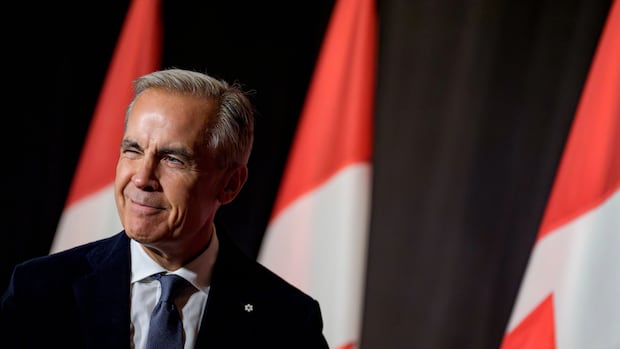
Prime Minister Mark Carney states that Canada is planning to start discussions regarding a ‘unique alliance’ with the European Union — but clarifies that it does not involve membership, or ‘associate membership,’ as reported by the Wall Street Journal. Former ambassador Stéphane Dion emphasizes that the issue of EU membership is a non-starter for various reasons.
The report elicited strong criticism from Conservative Leader Pierre Poilievre, who expressed on social media Sunday night that Carney is “completely out of touch.”
“We will NEVER be the 51st U.S. state,” Poilievre asserted. “And we will NEVER be the 28th EU state.”
A senior official from Canada, who provided information to CBC News on a non-attribution basis, indicated that there have been ongoing discussions on how Canada can enhance its relationship with Europe, aiming for increased sovereignty for the nation.
The official noted that Canada is not looking to compromise its independence for access and stated that the federal government prioritizes the outcomes of strengthened ties over the terminology used.
Furthermore, the official mentioned that the term “associate member” is among several titles that have been evaluated and that it was not Canada that proposed it. The government is still exploring what this relationship might entail and hopes to clarify details during the EU-Canada summit scheduled for the end of October.
Currently, the EU does not recognize any associate members, and historically, the bloc has adhered strictly to its membership criteria.
The EU’s regulations specify that only countries within Europe are eligible to apply for membership.
Carney is expected to address the European Parliament on Thursday.