Prime Minister Mark Carney has announced that Canada intends to initiate talks regarding a “unique alliance” with the European Union, clarifying that this does not equate to seeking membership. He is set to address the European Parliament later this week.
“We are not aiming to join the European Union,” Carney stated on Sunday night while on the red carpet at the Toronto International Film Festival. He made this appearance right after delivering a speech to inaugurate the two-day Canada Investment Summit, which kicks off on Monday.
“What we are pursuing — and what discussions will commence — is a unique alliance with the European Union. We align on values, share priorities, and possess very complementary strengths,” he added.
Carney’s remarks follow a report from the Wall Street Journal on Saturday, which indicated that he is advocating for a strengthened relationship between Canada and the EU’s 27-member bloc, instructing his team to explore the most ambitious options available, excluding full membership.
The Journal also mentioned that Carney proposed Canada adopt the designation of “associate member.”
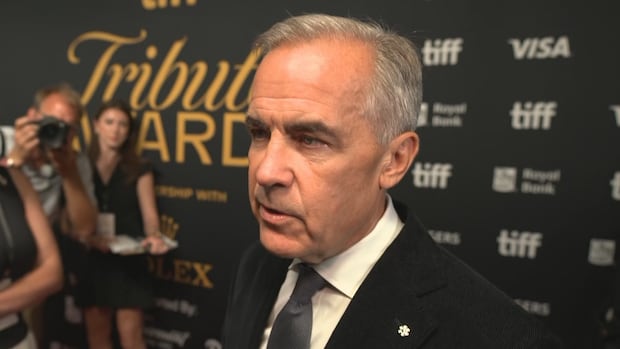
Prime Minister Mark Carney responded to a Wall Street Journal report at the Toronto International Film Festival, indicating that Canada is planning to pursue a ‘unique alliance’ with the EU, while not seeking membership.
This report has led to a strong backlash from Conservative Leader Pierre Poilievre, who expressed on social media Sunday night that Carney “could not be more disconnected from reality.”
“We will NEVER be the 51st U.S. state,” Poilievre asserted. “And we will NEVER become the 28th EU state.”
A senior official from Canada, who spoke to CBC on the condition of anonymity, revealed that discussions have been ongoing regarding how Canada can enhance its ties with Europe, aiming for increased sovereignty.
The official emphasized that Canada is not willing to sacrifice its independence for access, and the federal government is more focused on the outcomes of strengthened relationships rather than the terminology used.
The official clarified that the “associate member” designation is merely one of several options under consideration and that Canada did not initiate this suggestion. They also mentioned that the government is continuing to explore what this relationship might entail and hopes to outline it more clearly at the EU-Canada summit scheduled for the end of October.
Canada, the EU, and the U.S.
Recently, members of the cabinet have commented on the idea of Canada strengthening its connections with Europe as a means to reduce the country’s economic reliance on the United States.
“I believe Canadians should take comfort in the fact that we are exploring partnerships in a market that is essentially larger than the U.S. consumer market,” Finance Minister François-Philippe Champagne stated during an interview with CBC’s The House on Friday.
Canada and the U.S. remain embroiled in a contentious trade conflict, with Canada implementing $27.6 billion in counter-tariffs earlier this week. In response, the United States announced it would prohibit the importation of Canadian alcohol, motorcycles, and various other goods starting on September 29.
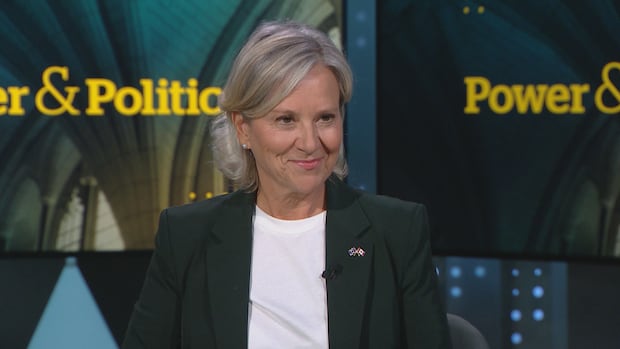
Power & Politics interviews EU Ambassador to Canada Geneviève Tuts as Prime Minister Mark Carney prepares to speak to the EU Parliament next week. Tuts emphasizes the importance of deepening Canada-EU relations in light of recent actions by U.S. President Donald Trump.
In a recent interview with Power & Politics, EU Ambassador to Canada Geneviève Tuts expressed that the two entities already collaborate effectively, but both are eager to “advance beyond the current state.”
“We are not only looking for a new partnership but something entirely new, and in many ways, something distinct,” Tuts remarked. “We aspire to redefine the relationship between the EU and Canada.”
Carney is scheduled to travel to Strasbourg, France, on Tuesday and will speak to the European Parliament on Thursday, following an invitation from President Roberta Metsola.
Additionally, Canada will host the EU summit on October 29 and 30.