
A groundbreaking revelation has been made by scholars at the University of Alberta, suggesting a raptor dinosaur could have preyed on a significantly larger tyrannosaur.
The researchers detected bite marks on the jaw of an Albertosaurus, a close kin of the Tyrannosaurus rex, which inhabited Alberta around 70 million years ago and is often likened to its “adolescent cousin.”
The fossil belonged to an eight-year-old Albertosaurus, an immature individual that had not yet attained full size. The presence of bite marks prompted two widely different theories on what might have occurred to the dinosaur post its demise near Drumheller, Alta., approximately 130 kilometers northeast of Calgary.
The prevailing belief among researchers is that a raptor, a smaller, bipedal carnivorous dinosaur, scavenged on the larger Albertosaurus after its death from unknown causes.
Philip Currie, a professor of dinosaur paleobiology at the University of Alberta, described this event as a rare instance where carnivore-on-carnivore feeding behavior has been documented.
Currie further emphasized the significance of the finding, highlighting the dominant predatory nature of the Albertosaurus during its era.
This discovery has the potential to shed light on the interactions between carnivorous dinosaurs and the intricacies of the ancient food chain.
Joshua Doyon, a master’s student specializing in paleontology at the University of Alberta, spearheaded the investigation into the bite marks.
Through analyzing the spacing between the marks and comparing them with the teeth of other contemporary carnivorous dinosaurs, researchers concluded that a raptor was the most plausible explanation.
Alternatively, it is postulated that the Albertosaurus might have been cannibalized by a much younger member of its own species, measuring less than two years old and roughly two meters in length.
Discovery Leads to Research Endeavor
The fossil was unearthed in 2022 by a member of the public exploring the badlands north of Drumheller while canoeing. The discovery was reported to the Royal Tyrrell Museum, which recovered the specimen and meticulously prepared it by removing the surrounding rock.
During the reassembly of the fossil by museum staff, the tooth imprints were noticed, paving the way for Doyon’s research initiative in 2023.
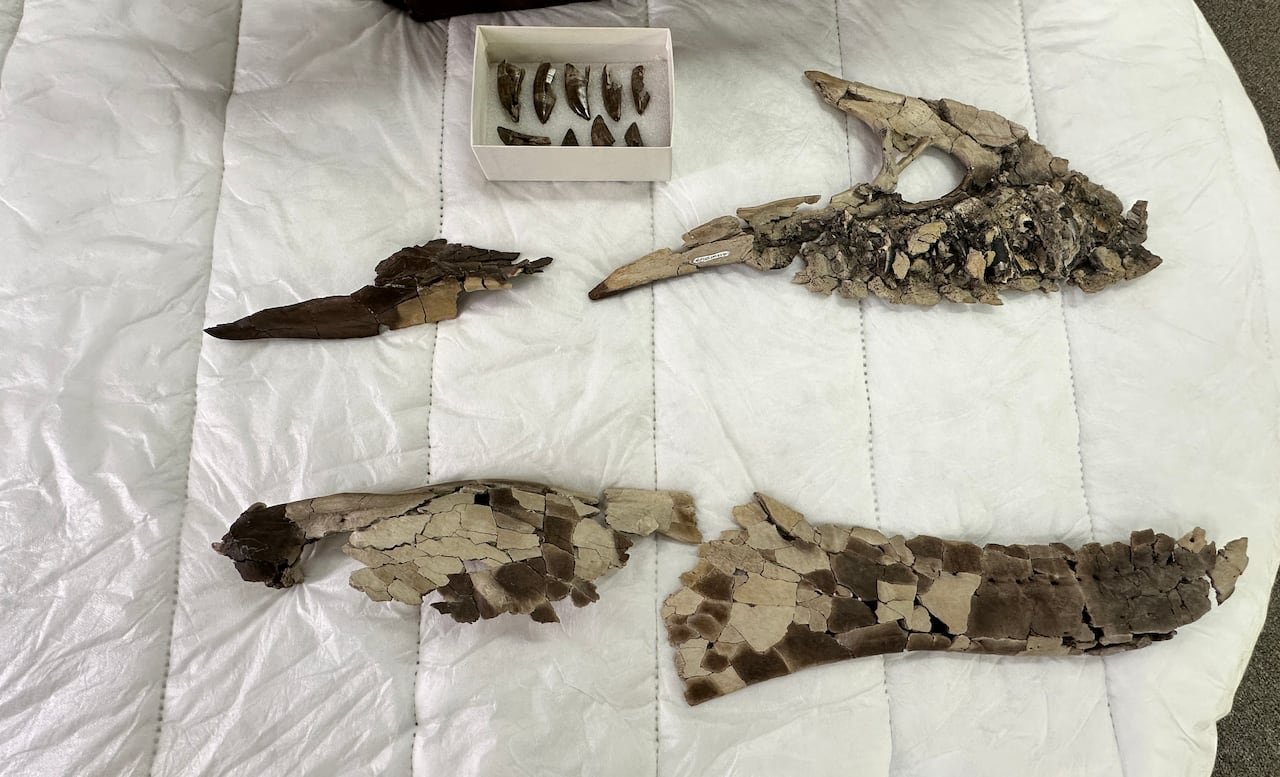
A close-up view of the fossils utilized in Doyan’s research. (Scott Neufeld/CBC)
Doyon expressed his interest in exploring dinosaur behavior and interspecies interactions when he approached museum researchers regarding potential projects.
The specimen presented an opportunity to delve into a feeding interaction that occurred tens of millions of years ago.
Currie underscored how paleontologists can glean valuable insights into dinosaur biology by scrutinizing details on fossils, rather than solely focusing on identifying and categorizing the creatures.
Specifics such as tooth imprints could aid researchers in better comprehending predator-prey relationships and species dynamics within ancient ecosystems.
While the Albertosaurus held an apex predator status in its ecosystem, the presumed raptor would have been significantly smaller, akin in size to a German shepherd, as per Currie’s explanation.
<p class="paragraph-b3




