Jensen Huang, the co-founder and CEO of Nvidia, known for his signature leather jacket and penchant for signing autographs, has become a fundamental figure in the AI chip manufacturing industry.
However, with an investigation currently in progress to determine if Huang was a target of foreign intelligence, concerns are mounting about his potential replacement if it becomes necessary.
This inquiry was prompted by a report from the New York Times last week, which disclosed Huang’s close romantic involvement with Alice Huang, a Chinese tech executive suspected of espionage for China. The timeline of their meeting remains uncertain, but the couple was seen together in 2024.
On Sunday, Nvidia’s board stated that it had no evidence to suggest the compromise of state or corporate secrets, but they are conducting an independent investigation in response to the allegations. Additionally, U.S. House Republican committee leaders have requested a briefing from Jensen Huang regarding his relationship with the aforementioned woman.
In a communication to his employees, Huang acknowledged his affair and expressed remorse to his family and colleagues for breaching their trust.
“I am completely dedicated to Nvidia and will strive to restore your faith in me,” he conveyed.
Huang will continue as CEO during the investigation. However, should the board decide to remove him or if he chooses to resign, tech analysts like Dan Ives suggest that finding a suitable successor would be exceedingly difficult.
“In my view, Jensen is irreplaceable,” remarked Ives, partner and senior managing director at Yorkville Ives & Co., a modern merchant bank located in New York. “Nvidia’s success is largely due to Jensen.”
‘The king of tech’
Nvidia started as a graphics card manufacturer in 1993, but company leaders, particularly Huang, recognized that their graphics processing units could serve purposes beyond gaming. The firm shifted focus to creating chips for supercomputers in the early 2010s, anticipating an AI surge that wouldn’t materialize for several years.
An initial collaboration with OpenAI paved the way for a long-term partnership with the creators of ChatGPT, which continues to depend on Nvidia’s chips for its technology today. Companies like Amazon, Meta, Google, along with nearly all firms developing AI technologies, rely on Nvidia’s hardware to support their operations.
Currently valued at approximately $4.5 trillion, Nvidia ranks as the second most valuable company globally and is essential to the entire AI ecosystem, according to Ives.
-
Nvidia probes whether CEO Jensen Huang targeted by foreign intelligence as he admits affair
-
Can AI be regulated? Why experts say government intervention is needed — but could be tricky
From his prominent position within the company, Huang has gained a celebrity-like status, often signing autographs for fans during public events. One of his iconic leather jackets was auctioned for over $1 million earlier this year.
“He has reached a level where he is almost regarded as the king of tech. Everyone pays attention to what Jensen says,” commented Bob O’Donnell, president and chief analyst at Technalysis Research.
Beyond Nvidia, Huang has also supported the expansion of AI, financially backing ventures like cloud computing firm CoreWeave and Anthropic, the creator of the Claude chatbot. He has dismissed concerns regarding an AI bubble and countered dire warnings about the technology posing an existential threat to humanity, while establishing a close relationship with U.S. President Donald Trump.
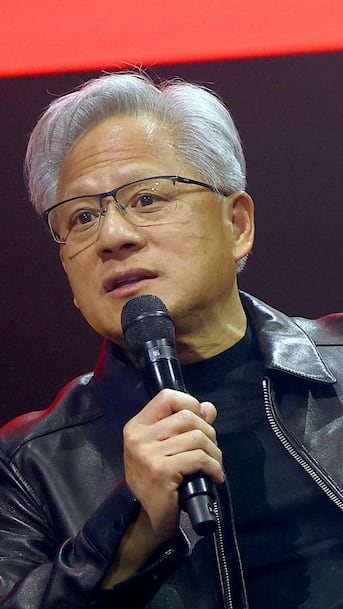
Nvidia is conducting an internal probe following a media report that CEO Jensen Huang had a close relationship with a Chinese businesswoman who allegedly passed information to Beijing. Nvidia’s shares fell nearly six per cent in early morning trading. At the current levels, the chipmaker would lose around $280 billion US in value from its last closing price.
Ives believes that losing Huang’s influence would significantly impact the industry if he were to depart.
Currently, Huang has fostered an unusually flat organizational structure, with many employees reporting directly to him instead of to senior executives. Earlier this year, Huang mentioned in a podcast that up to 60 individuals reported directly to him.
On the company’s website, only a few high-ranking executives are listed apart from Huang.
Additionally, two of Huang’s children work at the firm — his son Spencer serves as the director of product for robotics, while his daughter Madison holds the position of senior director of product marketing.
No clear successor
Given Huang’s long tenure at Nvidia, analysts express concerns about the absence of an obvious successor.
“There isn’t one person, two people, or even three who could take Huang’s place. That’s a troubling prospect for investors, especially in this moment of uncertainty,” Ives stated.
Should Huang be compelled to resign, Ives fears that Nvidia may struggle to recover fully from the loss of his leadership, considering his crucial role in the firm’s expansion.
Conversely, others argue that within a corporation as large as Nvidia, there are individuals capable of stepping into the top position.
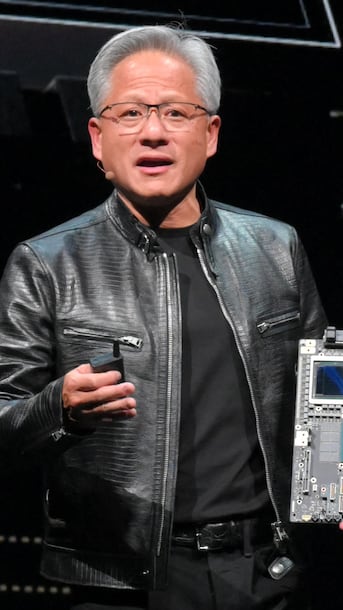
U.S. tech giant Nvidia’s shares tumbled after CEO Jensen Huang admitted to an affair with a woman accused of spying for Beijing. Andrew Chang breaks down what we know so far and what the scandal means for the world’s most valuable AI chipmaker.
“A company of this magnitude cannot be built by one individual alone; it’s simply not feasible. There’s a vast team of highly skilled and capable individuals,” O’Donnell asserted.
While he concurs that the absence of Huang would be significant, he believes the technology roadmap — which outlines plans for the upcoming years — is already established, simplifying the task for any potential successor.
O’Donnell anticipates that Nvidia is positioned to maintain its leadership among chip manufacturers for the foreseeable future, and he does not foresee a major upheaval at the top affecting this status.
Moreover, with the board expressing confidence in Huang, O’Donnell does not believe the members will attempt to remove him.
Nonetheless, should Huang remain as CEO, his authority over the company is likely to loosen in the future, as other senior executives will probably take on more prominent roles as spokespersons and negotiators at least part of the time.
“Replacing an iconic figure who has a unique presence is challenging,” he stated. However, “if the board acts wisely, and I trust they will, they will understand the necessity of addressing this situation to help restore confidence in the company.”