During her inaugural Olympic appearance at Tokyo 2021, Kate Van Buskirk achieved her second fastest time in the women’s 5,000 meters under extreme heat, reaching 41°C.
This was a remarkable accomplishment, and she collapsed on the track afterward to fully absorb the moment.
Five years later, Van Buskirk describes that experience as the most “egregious” moment caught on camera, with images circulating online showing her “sprawled out” on the track from highly invasive angles.
“I had just completed the most significant race of my life… I remember seeing those images and thinking, ‘these will be on the Internet forever,’” Van Buskirk remarked, noting that there were also other photos that depicted her moment in a more respectful manner.
Such occurrences are not uncommon in women’s sports.
A study by The Representation Project during the Tokyo 2021 Olympics revealed that female athletes were sexualized almost ten times more than their male counterparts at the Games, despite Olympic broadcasters urging camera operators to focus on “sport appeal, not sex appeal” prior to the events.
“It ought to focus on performance, not appearance,” stated Van Buskirk, who has since retired and now serves as a track and field analyst. “Even if unintentional, we need to consider how photographers are positioned to prevent them from capturing just that one angle.”
For many years, the design and fit of women’s sports uniforms have sparked discussions, including the recent controversy surrounding Nike’s introduction of a high-cut bodysuit for women’s Team USA track and field ahead of Paris 2024.
Van Buskirk refers to her track uniform as her “equipment,” preferring to wear bottoms known as “bunners.”
“I aim to wear the least amount of fabric possible while still maintaining the dignity to compete seriously as an athlete, and I don’t want to be distracted or worried about whether I’m adequately covering my private areas,” she added.

More athletes are speaking out about invasive camera angles at women’s athletics competitions.
Europe pushing for change from broadcastersÂ
In July 2026, the European Broadcasting Union and European Athletics established new guidelines aimed at enhancing coverage in women’s athletics, addressing problematic broadcasting practices that “add zero narrative value.”
The report, Raising The Bar, identified lingering close-ups of specific body parts, low-angle camera placements, and excessive slow-motion replays lacking storytelling purposes as the primary “culprits.”
“The way audiences consume sports today can amplify that impact. A single frame from a live broadcast can be quickly clipped, zoomed in, and shared worldwide in a matter of minutes,” commented Elissavet Arapi, the women’s sport lead for the European Broadcasting Union.
“Such images can provoke sexualized comments and abusive behavior online, and athletes have expressed increasing concern regarding this issue.”
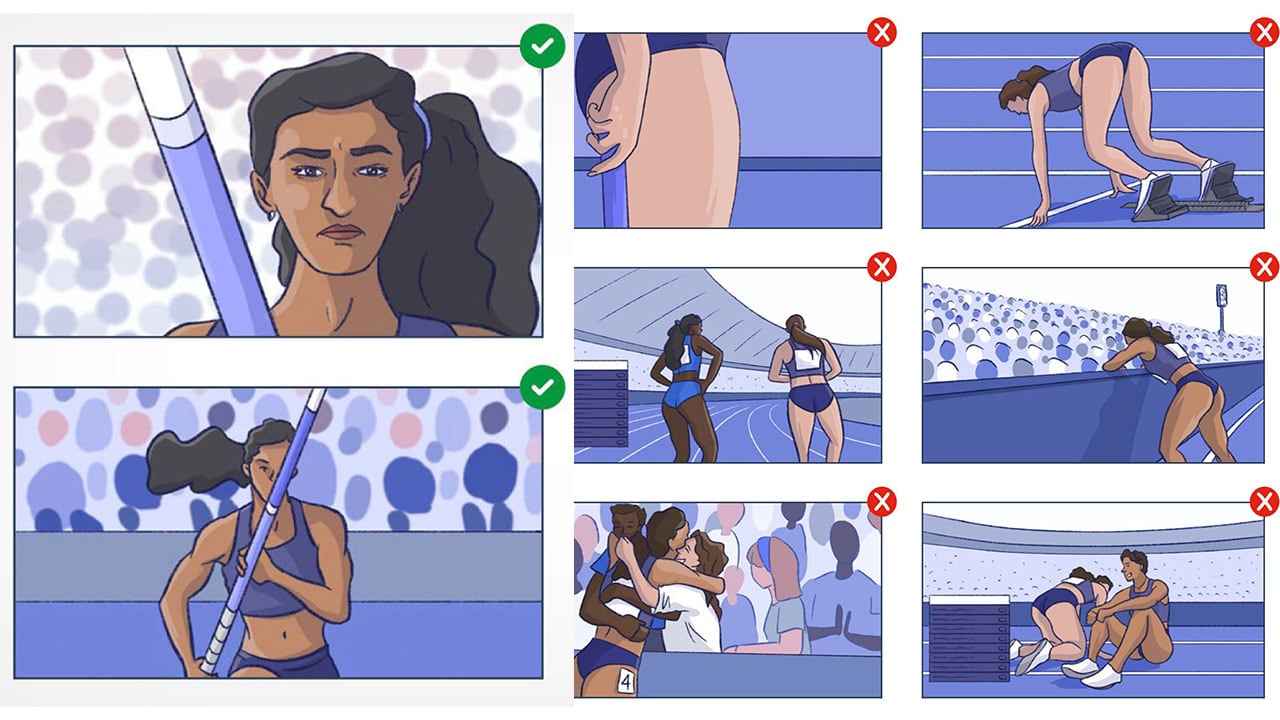
Above is a photo created by the European Broadcasting Union and European Athletics to show the encouraged standard camera angles in the broadcasting of womenâs athletics. (European Broadcasting Union)
Van Buskirk noted that several of her fellow athletes have discovered highly sexualized images of themselves taken during competitions on “soft core porn” websites.
“I have observed numerous replays of myself and others over the years where there’s no commentary accompanying them… It’s often a slow-motion pan that starts at the calves and moves up really gradually,” she commented.
Arapi stated that addressing editorial decisions like these requires collaboration among directors, video operators, and camera personnel who must “quickly respond if their shot results in a sexualized image.”
Michele Donnelly, an associate professor of Sports Management at Brock University, pointed out the shortcomings of the guidelines.
“Why isn’t this a policy? The entire document makes a compelling case for its necessity. It should be elevated to a requirement, not merely a guideline,” Donnelly stated. “The IOC (International Olympic Committee) must be the first to demonstrate and hold itself accountable for these standards.”
As Canada’s official broadcaster for the Olympic Games, Paul McDougall, CBC Sports’ head of production and content, emphasized that their priority is maintaining a focus on athletic excellence.
“Broadcasters owe women athletes not just a presence on screen but a broadcast that respects their power, skill, and dignity. Visibility inspires participation. By adhering to respectful production guidelines, we move beyond mere representation and commit to a framework where athletic excellence remains the primary focus,” McDougall stated.
The Olympic Broadcasting Services (OBS), the permanent host for all Olympic and Paralympic Games, has also implemented guidelines to guarantee respectful coverage of athletes.
“Respectful and proper portrayal of all athletes across all sports is a crucial aspect of OBS’s Olympic Games coverage. This commitment is evident in the OBS guidelines for venue production teams and is also considered in our production quality control processes when overseeing OBS coverage,” OBS shared in a statement to CBC Sports.

Germany’s Gina Lückenkemper, right, calls the upward facing cameras intrusive and uncomfortable while wearing her competition attire. (Petr David Josek/The Associated Press)
Education versus information
In 2019, the World Athletics Organization introduced two small cameras positioned inside the starting blocks for sprint and hurdle events during the world championships in Doha.
While the intention was to offer “trailblazing” angles that would capture the explosive starts of runners, the camera placement drew significant criticism from several sprinters. Notably, German athletes Gina Lückenkemper and Tatjana Pinto remarked that the upward-facing cameras felt intrusive and uncomfortable while they were in their competition gear.
“When your body is exposed… there’s an assumption of access and ownership, allowing images of women’s bodies to be used for any purpose people desire. This also translates into real-life interactions and expectations placed upon athletes,” Donnelly remarked.
In response to the backlash, the International Association of Athletics Federations (IAAF) agreed to limit the display of footage from block cameras to the moment the starting pistol fires and to erase video data at other times during the day.
“We have acknowledged specific feedback regarding the block cameras and have confirmed that we have appropriate measures in place to protect athlete privacy when selecting images for broadcast,” the IAAF stated. “We also maintain strict editorial guidelines for what is aired, and these have been followed since the championships began.”
While sexualization is not exclusive to female athletes, male athletes often celebrate when their bodies are featured on camera rather than facing threats, according to Donnelly.
“Without discounting the negative effects on many athletes, often when men’s bodies are sexualized, it is in a celebratory context. Consider the high jumper [Anthony Ammirati] from Paris 2024, where the focus was on his masculinity,” she noted.
This Friday, the world’s elite track and field athletes will compete at the World Athletics Ultimate Championship in Budapest, where intense rivalries and new talents will surface in preparation for LA 2028.
With athletics being one of the most viewed sports during the Summer Olympics, setting broadcasting standards is more crucial than ever.
“There’s a distinction between informing and educating versus entertaining. I believe once we shift to entertainment as the primary focus, it can quickly devolve into hyper-sexualization,” Van Buskirk stated.
“That is not storytelling; that is objectification,” Van Buskirk concluded.