Farzin Jafari is confronted with a daunting dilemma: he must either wait in hope that the Canadian government permits him and his family to stay in Canada, or leave his wife and young daughter behind, believing they may remain if he is found inadmissible and compelled to return to Iran.
“As a family, we are hanging by a thread,” he expressed. “If I let go of that thread, open my hand, and fall… at least my family might survive.”
Jafari is among what an advocacy organization claims are hundreds of permanent residency applicants who received a Procedural Fairness Letter (PFL) from Immigration, Refugees and Citizenship Canada in August.
The letters indicated that these applicants might be inadmissible to Canada due to their association with the Islamic Revolutionary Guard Corps (IRGC) and would need to demonstrate otherwise. In 2024, the Canadian government designated the IRGC as a terrorist organization.
“I am therefore concerned that you served in the IRGC and that you may be inadmissible to Canada under paragraph 34(1)(f) for being affiliated with an organization… engaged in terrorism,” the letter stated.
Jafari mentioned that he had no choice regarding where he was assigned for service.
“You can’t refuse or say, ‘I don’t want this,’” he remarked.
I’m not IRGC. I’m a victim of IRGC.Farzin Jafari
Iran’s Revolutionary Guards serve as a segment of the Iranian military, possessing extensive powers and reporting directly to the supreme leader of the nation. All Iranian males over 18 are mandated to fulfill compulsory military service.
Proof of service is essential for employment or passport acquisition, and conscripts have no say in the division to which they are assigned.
“If you skip this compulsory period, you lose your fundamental civil rights,” Jafari explained. “They essentially hold you hostage until you complete this service.”
Those who refuse to serve face the risk of imprisonment by the Iranian authorities.
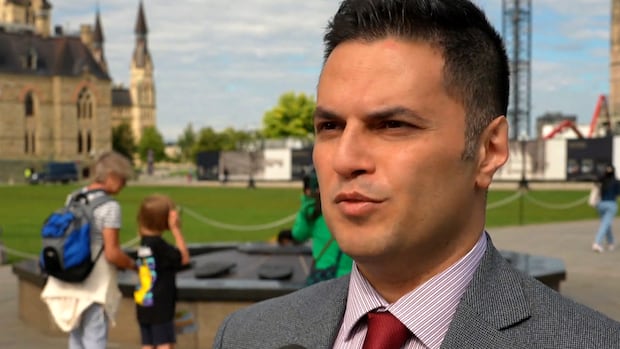
An Iranian man is one of hundreds told by the government that he may have to leave over his past mandatory service in the Islamic Revolutionary Guard Corps, which Canada considers a terrorist organization. Farzin Jafari says he had an administrative job in 2011, and has since protested the IRGC publicly.
IRGC designated a terrorist group
Jafari completed his compulsory military service in 2011. CBC News has reviewed his service completion card, which is issued by the Iranian military as proof of completing mandatory service.
He described his role as administrative, which involved recording license plates.
After his service, he worked as a software engineer in the private sector in Iran before relocating to Canada in 2021 to start a family.
His wife had faced brief detention by the morality police in Iran, prompting concerns for their safety. In Canada, he has dedicated much of his time to protesting the Iranian government and advocating for the IRGC to be classified as a terrorist organization.
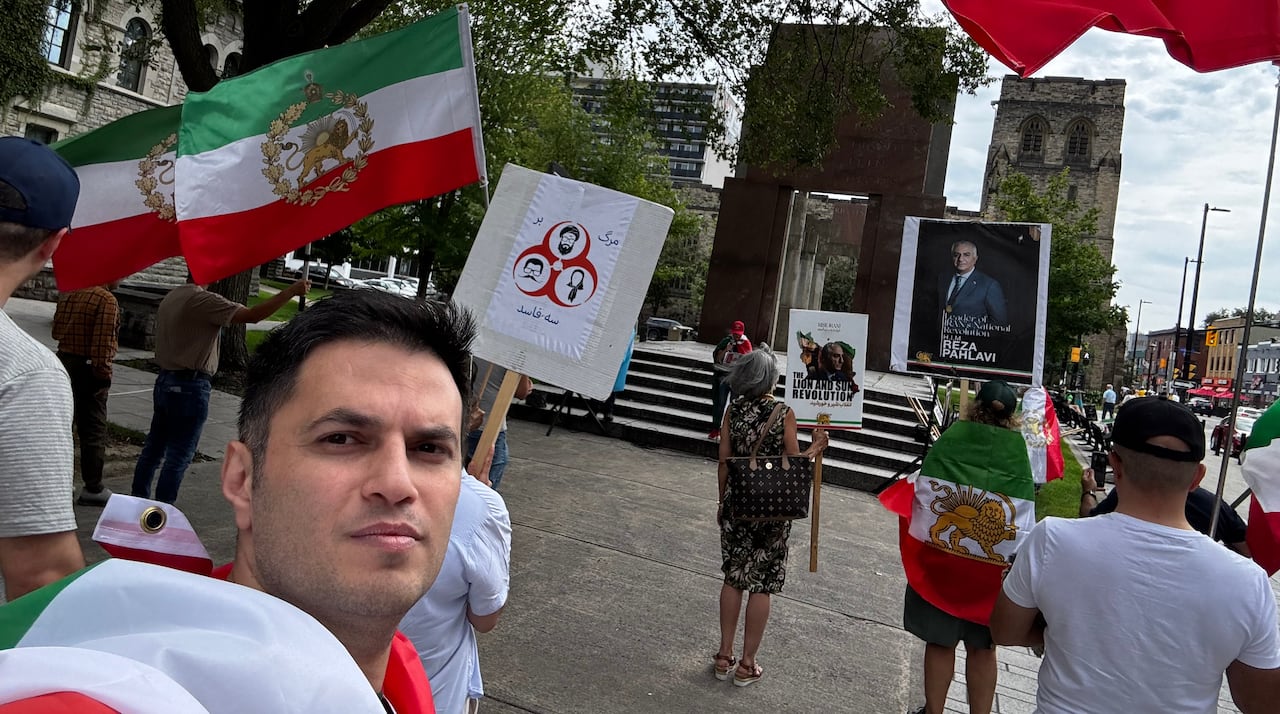
Jafari said he has attended protests against the Iranian government and the IRGC since coming to Canada in 2021. If he were to return to Iran, he said he could face retribution for criticizing the current regime. (Farzin Jafari)
In the winter of 2024, Jafari and his wife submitted their applications for permanent residency.
That summer, the Canadian government categorized the IRGC as a terrorist organization, citing the group’s support for various terror organizations, including Hezbollah, Hamas, the Palestinian Islamic Jihad, and the Taliban.
In January 2020, the IRGC shot down Ukraine International Airlines Flight PS752 over Tehran, resulting in the deaths of 175 people, including 55 Canadians and 30 permanent residents.
Justice Minister Arif Virani noted during the designation announcement on June 19, 2024, that the government was mindful of how this listing might affect individuals who were conscripted into the IRGC, but emphasized a “careful and measured” approach.
“If someone was conscripted at a certain time and no longer serves in the IRGC, that would influence the assessment,” he stated at that time.

The federal government is declaring Iran’s Islamic Revolutionary Guard Corps a terrorist entity under Canada’s Criminal Code after years of pressure. That means police can charge anyone who financially or materially supports the group and banks can freeze its assets.
When Jafari and his wife received PFLs due to his mandatory service, he was taken aback.
“I’m not IRGC. I’m a victim of IRGC,” he stated.
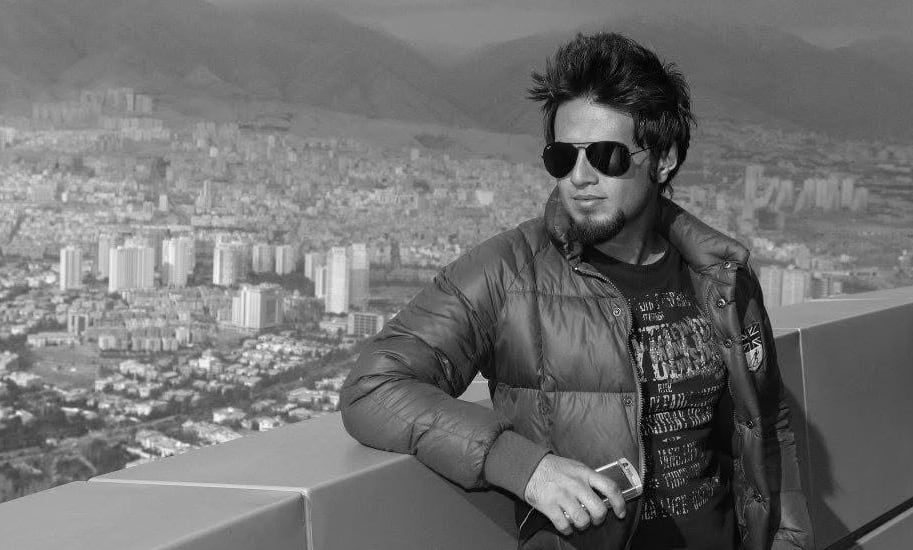
Jafari was born in Iran and worked as a software engineer for a private company after completing his mandatory military service. He and his wife came to Canada to start a family in 2021. (Farzin Jafari)
‘Hundreds’ of letters dispatched
Hundreds of applicants received similar letters on August 6 and 7, according to Nahid Rahmati, a spokesperson for the Unheard Conscripts Advocacy Network.
The organization aims to represent individuals conscripted into the IRGC and advocate for them within Canada’s immigration framework.
Rahmati noted that she has never seen anyone who received a PFL successfully gain entry into Canada.
“I have encountered numerous cases that were denied,” she remarked. “They received the PFL and were rejected.”
Immigration, Refugees and Citizenship Canada stated in a response that it could not confirm the quantity of letters sent to permanent residency applicants regarding potential ties to the IRGC.
-
Analysis
Are Iranian ‘sleeper cells’ a threat to Canadians? Here’s what intelligence experts say
-
Iranian dissidents in Canada say they’re being watched and under threat from the regime in Iran
CBC News interviewed several recipients of the letters, many of whom chose not to speak on the record due to fears of retaliation from the Iranian government.
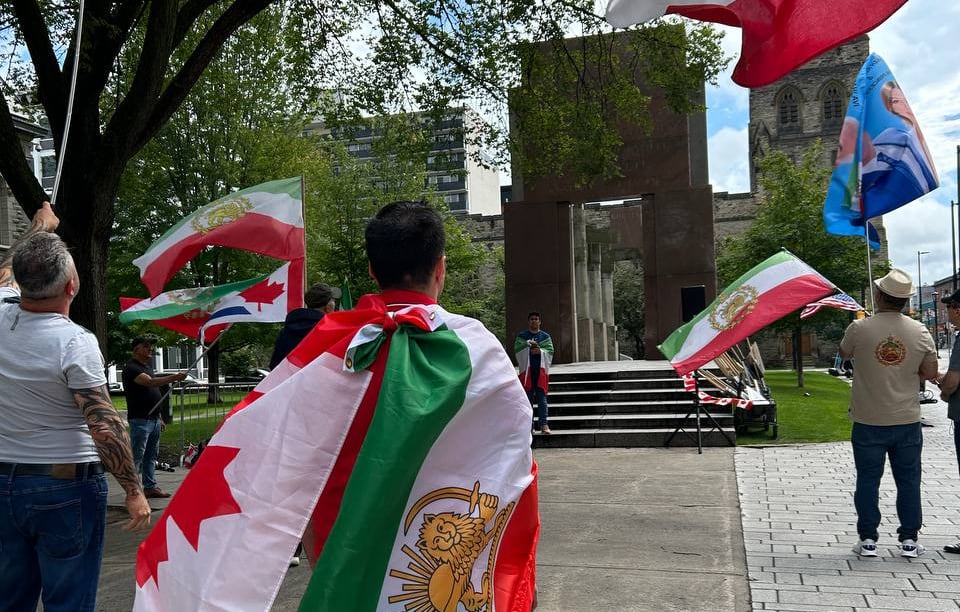
Many protesters are afraid to share their identity publicly for fear of retribution from the Iranian government. (Farzin Jafari)
Letters as part of a ‘normal’ procedure
In a statement, Canada’s immigration and citizenship department indicated that the designation of the IRGC as a terrorist entity necessitates an “assessment of inadmissibility concerns when applications suggest an association with the IRGC.”
“This is a standard aspect of applying Canada’s immigration laws and does not imply that every individual who served in the IRGC is automatically inadmissible,” the statement continued.
Conscripts noted that it is challenging to prove they did not engage with the IRGC following the end of their mandatory service. According to Hossein Raeesi, a criminal and human rights lawyer with two decades of practice in Iran, the IRGC does not maintain a record of those who leave.
“Someone who served compulsory military duty with the IRGC is not regarded as a member of the IRGC,” he stated.
CBC News inquired with the Canadian government about which documents would be accepted as evidence that an applicant was not affiliated with the IRGC beyond their mandatory service.
“There is no singular set of documents that applies to every situation,” the agency replied in its statement.
Conscripts served under pressure, according to lawyer
Many conscripts served under coercion, according to Arghavan Gerami, an immigration attorney based in Ottawa.
Two of her current clients have received PFLs, and she is concerned that Canada expects them to demonstrate attempts to resist conscription.

Ottawa immigration lawyer Arghavan Gerami has two clients who are currently awaiting an admissibility decision after receiving Procedural Fairness Letters from Immigration, Refugees and Citizenship Canada. (Francis Deschênes/CBC)
“What are we advising them to do? ‘Refuse, stand up to the regime?’” she questioned. “This is a nation that disregards the rule of law. We have witnessed them kill and shoot civilians and protesters.”
“These individuals have families and spouses. We are essentially asking them to defy that regime, refuse something that is compulsory, and put themselves at risk.”
She emphasized the necessity of denying entry to high-ranking IRGC officials and those who voluntarily enlisted.
“The focus should be on individuals known to be in Canada who are truly the key offenders.”
Living in uncertainty
Canada has temporarily halted the deportation of inadmissible individuals to Iran due to concerns over civilian safety amid ongoing conflicts in the Middle East.
If Jafari is determined to be inadmissible, he and his wife could be removed from Canada once the moratorium ends, potentially forcing them to take their infant daughter back to Iran.
For now, Jafari can only await the outcome.
“It’s an extremely desperate situation,” he stated.