This month, the Canadian Coast Guard’s most formidable icebreaker made a successful journey to the North Pole as part of efforts to settle territorial disputes in the Arctic.
The CCGS Louis S. St-Laurent, in collaboration with the Swedish icebreaker Oden, arrived at the North Pole on August 16.
The purpose of this polar expedition is to chart the Arctic Ocean floor using specialized sensors, which experts believe will aid in clarifying Canada’s territorial claims that overlap with those of Russia and Denmark through Greenland.

This trip marks the sixth occasion the vessel has made it to the pole, a location rarely visited by humans.
For Captain Byron Briggs, this was his inaugural experience at the top of the world.
“It was actually more thrilling than I had anticipated once we successfully reached the pole and maneuvered the ship until the GPS indicated we were at 90 North,” Briggs remarked, highlighting the pole’s latitude.
“It was a truly significant moment for me, without a doubt. And judging by the cheers from everyone else on the bridge, it was a monumental occasion for all of us.”
Briggs noted that they even had a chance encounter with Santa Claus upon their arrival at the North Pole.
On the ice, the crew engaged in a friendly hockey match.
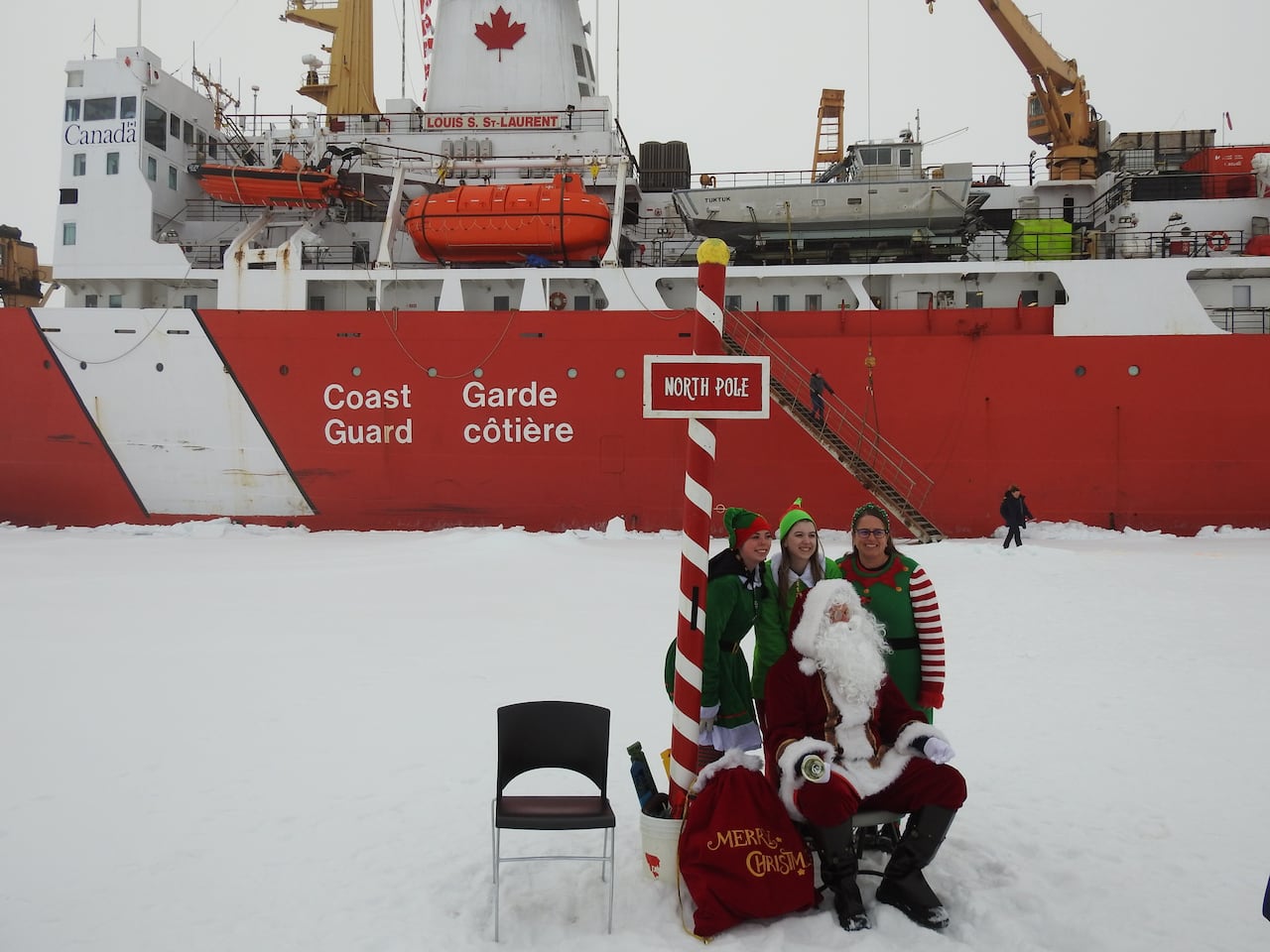
Crew dressed as Santa Claus and elves gathered for a photo at the North Pole (Submitted by the Canadian Coast Guard)
The vessel has a total crew of 77, consisting of 47 core members, along with a doctor and nurse, a helicopter flight crew, and a scientific team of 22.
In 2019 and 2022, Canada met its obligations under the United Nations Convention on the Law of the Sea (UNCLOS), submitting data that outlines the country’s claims regarding the ocean floor.
Leading the research effort is Kai Boggild, a scientist from the Geological Survey of Canada, who is gathering this data.
“[This data] illustrates where we believe these points are located,” Boggild stated.
The information gathered during this mission aims to support those claims, particularly concerning the Lomonosov Ridge, an underwater ridge that divides the Arctic Ocean into two basins.
Boggild emphasized that the significance of this expedition extends beyond geopolitical issues, as it will yield vital scientific information.
“There are numerous fundamental questions regarding our understanding of the Arctic’s formation,” Boggild explained.
“Thus, collecting this data for UNCLOS also allows us to gain deeper insights into the natural history of the Arctic Ocean and how it has evolved over millions of years.”
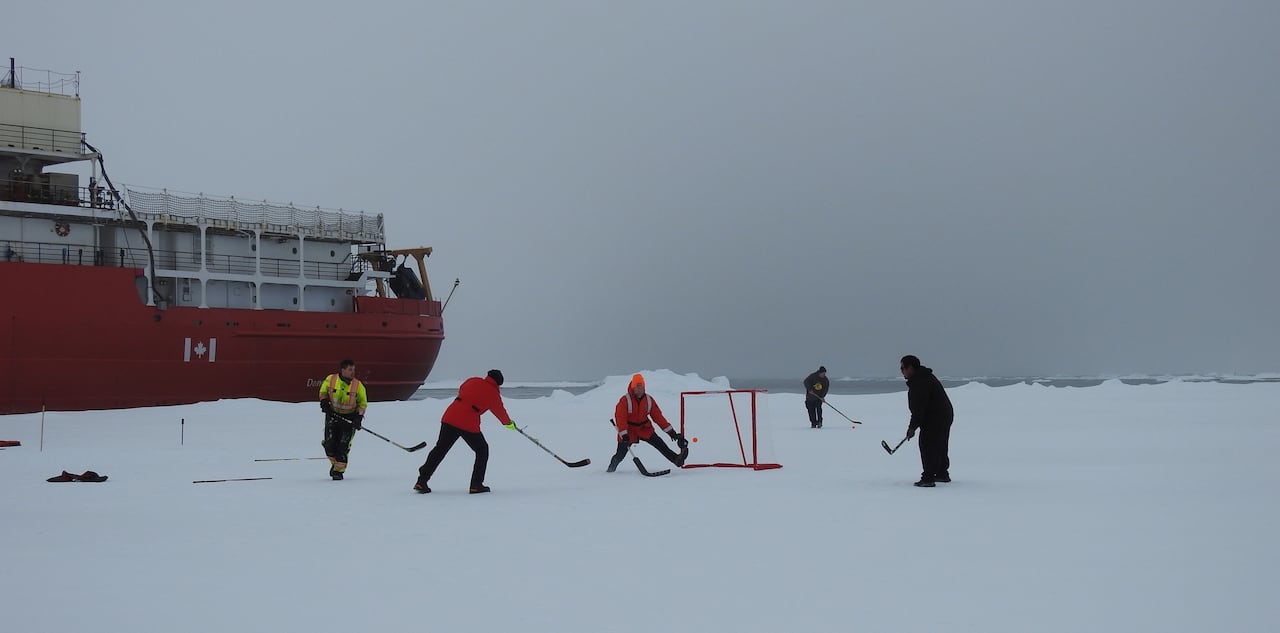
Crew members of the mission to the North Pole took part in a hockey game on the Arctic sea ice. (Submitted by the Canadian Coast Guard)
According to a statement from the Department of National Defence, Defence Minister David McGuinty remarked that the ship’s mission serves several purposes, including asserting Canada’s sovereignty in the area.
“The arrival of CCGS Louis S. St-Laurent at the North Pole signifies an important milestone that underscores Canada’s steadfast commitment to the Arctic,” McGuinty noted. “This mission enhances scientific understanding, bolsters our presence in the North, and reinforces Canada’s sovereignty and security.”
The crew of the Louis S. St-Laurent departed from their home port in St. John’s, Newfoundland, on July 8 and is anticipated to return in early November.