Researchers from Ocean Networks Canada have detected unprecedented water temperatures along the coast of British Columbia this month, indicating that an El Niño phenomenon is emerging alongside existing climate change effects.
The initiative at the University of Victoria manages two underwater observatories linked by cables to various research stations, including one situated off Vancouver Island, which recorded a temperature of 8.21°C at a depth of 400 metres on November 8.
This measurement at the Barkley Canyon Upper Slope was 2.49°C above the long-term average for the site, where data collection began in 2009, and it surpassed the previous record set in 2019 by 0.89°C, according to a statement released by the organization on Tuesday.
El Niño occurs when winds that usually drive warm water towards the western Pacific near Australia and Asia weaken or reverse, as described by Jay Cullen, an oceanographer and interim president of Ocean Networks Canada.
During an El Niño event, he explained, warm water “sloshes back” eastward and disperses once it reaches the western shores of North and South America.
“For us here in British Columbia, that warm water moves as a confined wave along the coastline,” Cullen stated, adding that it also modifies atmospheric circulation, which could lead to increased rainfall and reduced snowfall in coastal regions this winter.
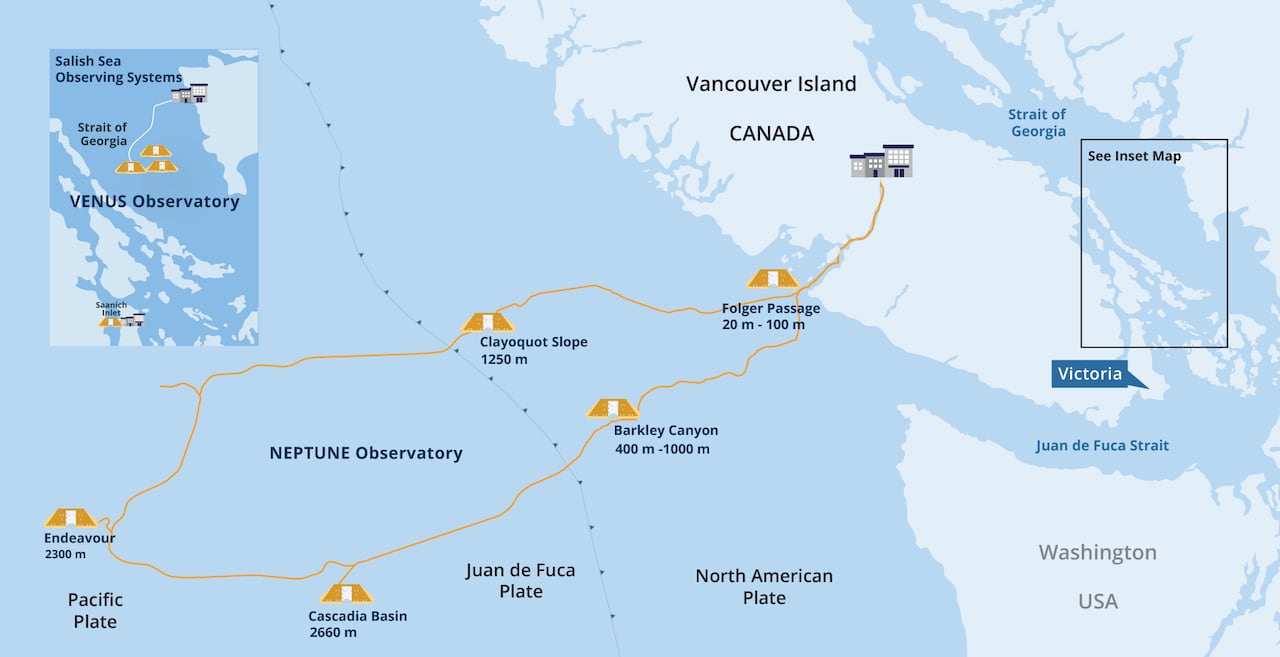
This image shows graphic, provided by the Ocean Networks Canada, shows the location of ocean research sites. (Handout by Ocean Networks Canada/The Canadian Press)
El Niño is a natural phenomenon. However, it is occurring against a backdrop of long-term global warming that is already placing stress on ecosystems and species, Cullen noted.
The rise in water temperatures results in lower levels of dissolved oxygen in regions that are crucial for salmon and herring fisheries, as well as habitats for notable species, including the endangered southern resident killer whales in the Salish Sea, he added.
Economic activities in the area, such as the Port of Vancouver’s Roberts Bank facility, are also impacted, where the federal government has supported a proposal for a significant expansion.
“Increased shipping and economic development along our coast must be accompanied by monitoring and environmental stewardship,” Cullen emphasized.

Jay Cullen, interim president and CEO of Ocean Networks Canada, said the high ocean temperatures could impact sensitive species. (Handout by Ocean Networks Canada/The Canadian Press)
He expressed concern regarding the elevated temperatures found deeper in the ocean, as many organisms dwell or retreat to these cooler depths.
“If the warming linked to El Niño affects not only the surface but also extends to considerable depths, it further stresses the ecosystem,” he remarked.
Additionally, El Niño causes higher water levels, which increases the likelihood of coastal flooding.
“We are observing about a 15-centimetre rise in sea level,” Cullen stated.
“With winter storms and king tides, the risk of coastal flooding is heightened, compounded by an already warmer and elevated sea level than what we’ve historically experienced.”
-
Meteorologists are forecasting a ‘super’ El Niño. What does that mean for B.C.?
-
What does a super El Niño mean for the Vancouver Island snowpack?
A graph shared by Cullen’s team illustrated a significant rise in the daily average temperature at the Barkley site starting in late October.
Cullen noted that this indicates the influx of warm water from the equatorial Pacific is reaching the coast of British Columbia, although calmer winds have also contributed to a decrease in the “upwelling” of cooler water from greater depths.
“Recently, those upwelling winds have weakened, making the arrival of this warm water appear more pronounced,” he added.
The Clayoquot Slope, a deeper location over 1,200 metres below the surface, has also recorded temperatures that are “significantly” above average, according to Cullen’s group.
Conversely, the Cascadia basin, the deepest site in the cluster off Vancouver Island at 2,650 metres, remains within typical temperature ranges.
Cullen indicated that the El Niño phenomenon is expected to reach its peak early next year and will “relax” as spring approaches.
Ocean Networks Canada is collaborating with the Fisheries Department to monitor the El Niño and its impacts along the coast of British Columbia, he added.
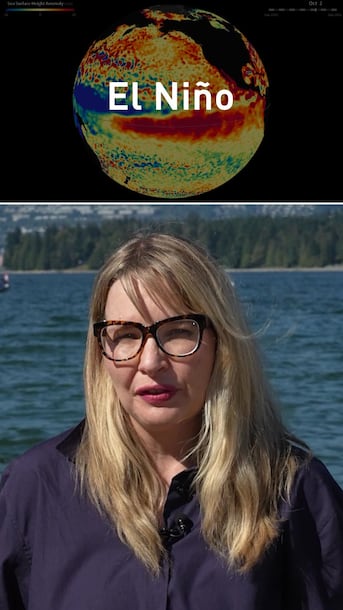
Regarding El Niño’s broader effects across Canada, Bill Merryfield, a research scientist with Environment and Climate Change Canada, previously informed CBC News that these typically do not manifest until late December.
“They tend to intensify as we progress into winter,” he noted.
Merryfield added that a warmer winter, influenced by El Niño, could lead to a reduced snowpack on the West Coast.