On a Tuesday afternoon in Calgary’s Confederation Park, Stephen Carter expresses his expectations for Alberta’s upcoming referendum regarding separation: he hopes for an 80/20 majority in favor of remaining part of Canada.
“If the results are close, we will be dealing with this issue indefinitely,” Carter remarks about the ongoing debate on Alberta’s independence.
“That would be the most unfavorable outcome.”
While at the park, Carter distributes lawn signs stating “Stay in Canada.” However, he insists that individuals cannot simply take one item of campaign material.
“They must take two signs, along with some brochures and buttons, because each of those items can spark conversations,” Carter explains.
Carter, who has a long history as a vocal political strategist, has collaborated with various politicians in Alberta, such as Naheed Nenshi, Alison Redford, and Danielle Smith.
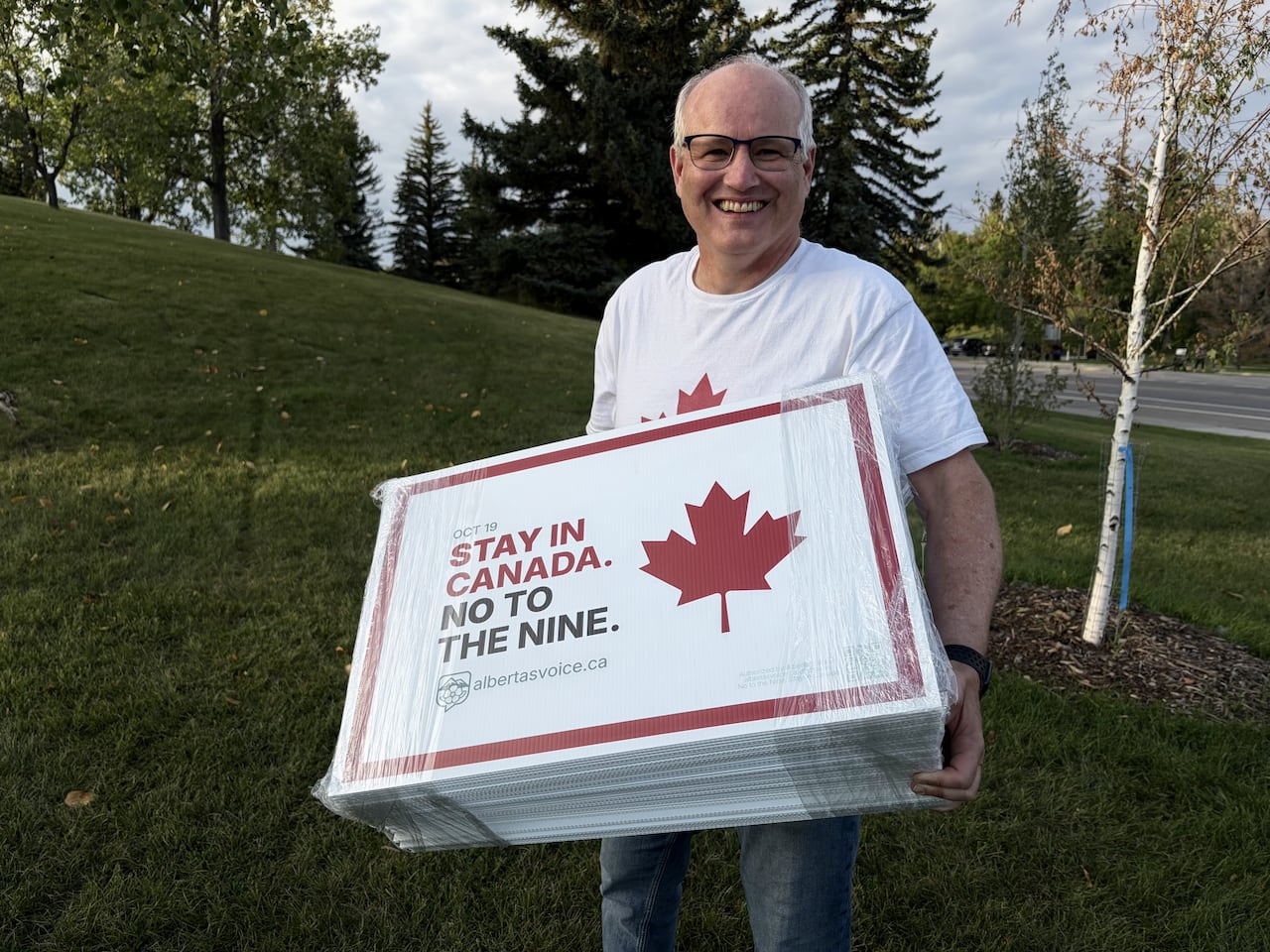
Stephen Carter, a federalist associated with Alberta’s Voice, expresses concern that voters may be discouraged by the consistently low support for separation and choose to abstain from voting. (Jennifer Chevalier/CBC)
However, this campaign presents unique challenges — and Carter is anxious.
“[Albertans] believe we will win decisively,” Carter says. “And as a result, why would they take the time to vote, especially when that involves answering nine questions they are unfamiliar with?”
Indeed, polling has consistently indicated that a large majority of Albertans support remaining in Canada, while only about 22 to 27 percent favor initiating the legal steps needed for a second, binding referendum on independence.
This poses a troubling dilemma for Carter and other federalist campaigns in the province: their base might stay home, assuming the outcome is assured. Additionally, they face fervently motivated separatists who are dedicating significant time and resources to their cause, banking on a subdued turnout from federalist supporters.
-
Two sides in Alberta separation debate entrenched, with majority wanting to remain in Canada: poll
-
Alberta independence group releases its ‘transition plan’ to become a country
John Ellard, a social psychologist who visited Carter’s setup, shared his concerns.
“I’m genuinely worried we may witness a repeat of Brexit, where many individuals think, ‘No, the polls suggest we will remain in Canada,'” Ellard stated.
Carter mentioned that part of the issue is his lack of data to identify who and where he should concentrate his campaign efforts.
“Historically, we have built capacity in our political system year after year, election after election,” Carter noted. “[But this time] we lack a historical framework … we don’t have the ability to reach out to individuals.”
A report released Wednesday by the Calgary Chamber of Commerce asserts that Alberta’s separation from Canada could decrease the provincial economy by $62 billion annually. As CBC Calgary’s Joel Dryden reports, an advocate for Alberta independence claims the report plays on people’s fears rather than highlighting potential opportunities.
This absence of precedent also presents challenges for Janet Brown, a leading pollster in Alberta and the founder of Janet Brown Opinion Research.
Regardless of how often she surveys respondents about separation, the outcome remains unchanged: approximately 25 percent express support for independence, with typical margins of error.
However, as Brown explained to CBC’s The House, an unbalanced voter turnout could disrupt everything.
“If we encounter a situation where all separatists turn out to vote, and only half of federalists do, then the polling we’ve conducted could be rendered meaningless,” Brown said.
Engaged and motivated separatists
Approximately 150 kilometers north in Red Deer, Gerry Bennet sits at a table displaying a blue Alberta flag on one side and a Canadian flag on the other, waiting for Keith Wilson, leader of the independence group Let Alberta Decide, to arrive.
Bennet, a supporter of separation, believes that nothing Prime Minister Mark Carney or the federal government could say would change his perspective. During the interview, he becomes emotional as he reflects on the future for his children and grandchildren.
“Taxes are extremely high, and grocery prices are soaring. Just surviving is a daily challenge. It’s a difficult situation,” Bennet stated.
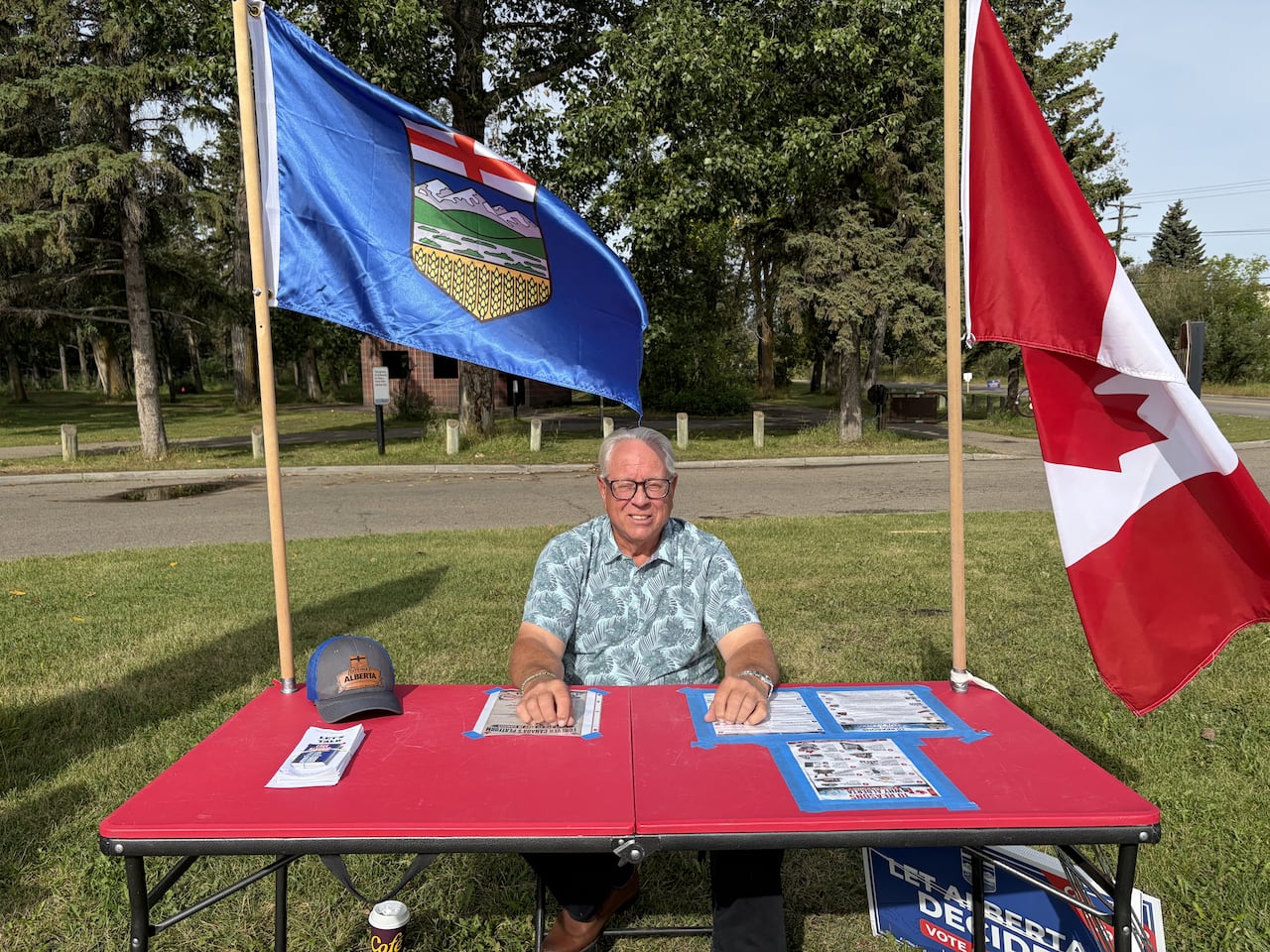
Gerry Bennet, a separatist in Red Deer, Alberta, urges undecided voters to support advancing the idea of independence as a way to communicate their views to the federal government. (Jennifer Chevalier/CBC)
Despite being in the minority in Alberta, Bennet and his fellow separatists are quite active. According to Elections Alberta data, third-party advertisers advocating for separation have raised around $925,000 so far.
In contrast, registered federalist organizations have accumulated $277,000.
Bennet encourages undecided Albertans to vote to initiate a binding referendum process, emphasizing that they can still oppose separation later.
“Send a message to Ottawa, and let’s see how it unfolds from there,” Bennet urged.
Carter cautioned that this could be a risky bet that might result in an exodus of industries and businesses uncomfortable with the uncertainty, reminiscent of the events surrounding the Quebec referendum in 1995. Several business leaders in Alberta have recently echoed similar concerns.
“We definitely do not want to replicate that experience,” Carter insisted. “If you believe that separation will make us wealthier, you are mistaken.”
In an interview with The House, Wilson minimized fears regarding economic repercussions, asserting that Alberta possesses leverage over various provinces that would help solidify its markets as an independent entity.
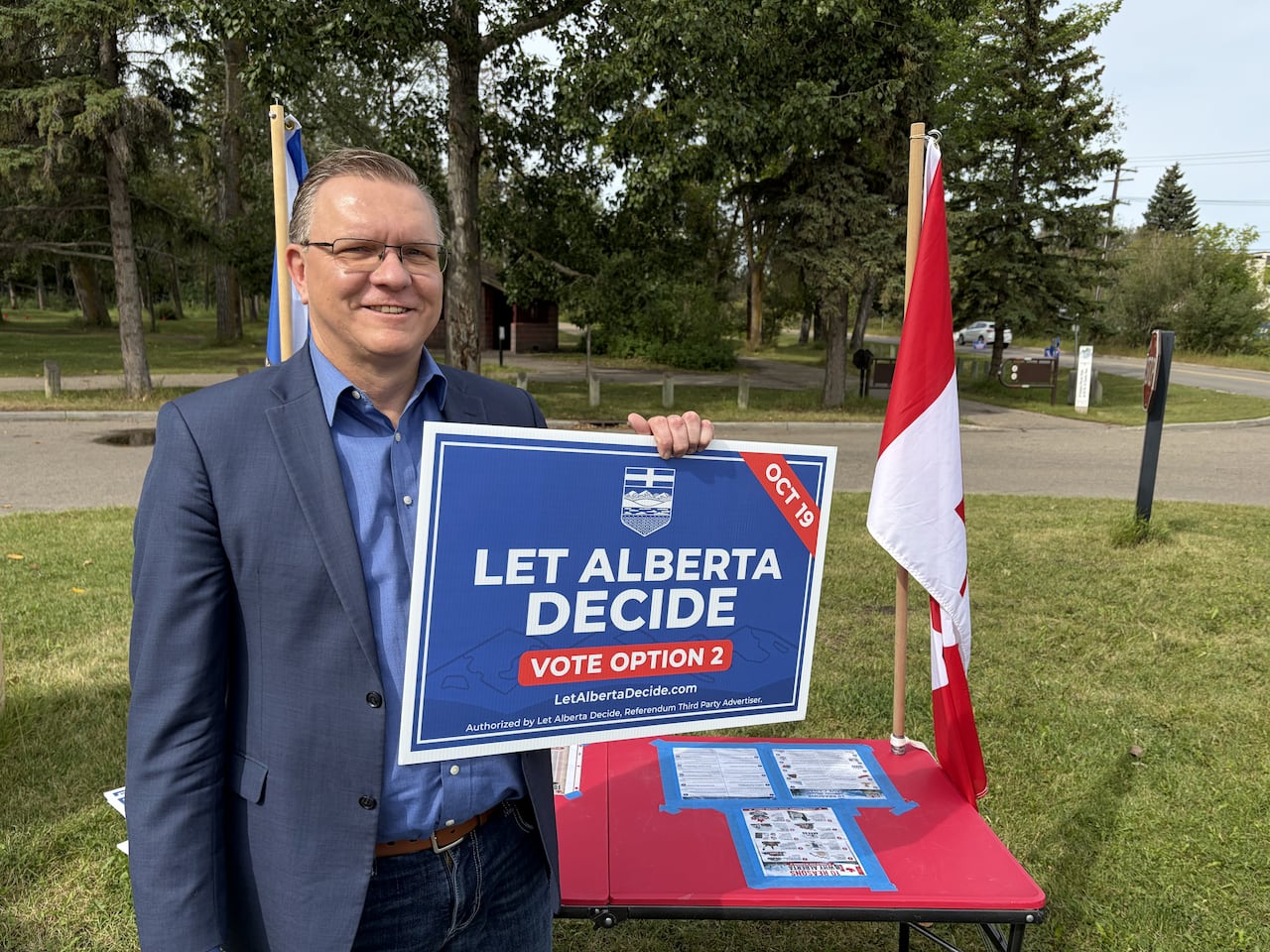
Keith Wilson, leader of the Let Alberta Decide independence group, expresses confidence despite polling indicating low support for separation, as he believes the final phase of the campaign is what truly counts. (Jennifer Chevalier/CBC)
‘We’re an energy superpower’
“A significant portion of British Columbia’s economy must be transported east to reach eastern markets, not just within Canada but extending to places like Chicago,” he stated.
“We likely have more [oil] refineries than all other provinces combined,” Wilson continued. “We are an energy superpower, and our products supply refineries in Ontario and even Quebec.”
When asked about the persistent polling that suggests minimal support for separatism, Wilson expressed no concerns. He emphasized that the critical period of any campaign is the final stretch — in this case, the two weeks leading up to the vote on October 19.
“My joke is, ‘Yeah, there’s no chance for us to win. You guys don’t even need to vote. Just stay home; you’ve got this. Trust the polls, you’re fine,'” Wilson laughed.
As the voting date approaches, Carter expresses his hope for an 80/20 split, acknowledging the historical inclination towards separatism in Alberta.
However, he is unwilling to go further than that.
“I firmly believe we are better off in Canada, and the 80 percent of Albertans who share this view are the prevailing force,” Carter stated. “We should not be subjected to the whims of a vocal minority.”