Scott Moe, the Premier of Saskatchewan, has declared a retaliatory tax on alcoholic beverages from the United States.
“A 50 percent tariff has been imposed on Canadian alcohol exports to the U.S., and starting September 8, Saskatchewan will implement a corresponding tariff on American alcohol entering our province,” Moe stated during a press conference held in Prince Albert on Wednesday.
On Thursday, the province elaborated that a “50 percent markup” would be applied to the price of American alcohol sold to retailers.
According to the province, this alcohol tax will be collected by and remitted to the Saskatchewan Liquor and Gaming Authority, and it will not be an expense for the SLGA.
Moe emphasized that the province is not contemplating removing U.S. alcoholic products from store shelves. He mentioned that the decision to purchase U.S. products would be left to the consumers in Saskatchewan.
On Tuesday, the federal government of Canada revealed counter-tariffs on $27.6 billion worth of U.S. goods, alongside a $7.5 billion support package for workers and businesses.
Moe expressed his support for the federal government’s “focused and targeted strategy regarding its counter-tariffs on U.S. imports,” following the collapse of trade negotiations over the weekend.
He accused the U.S. of “violating international trade agreements,” which he deemed unacceptable. Moe noted that Saskatchewan has been striving to enhance trade relations beyond North America, and that these initiatives have yielded positive results.
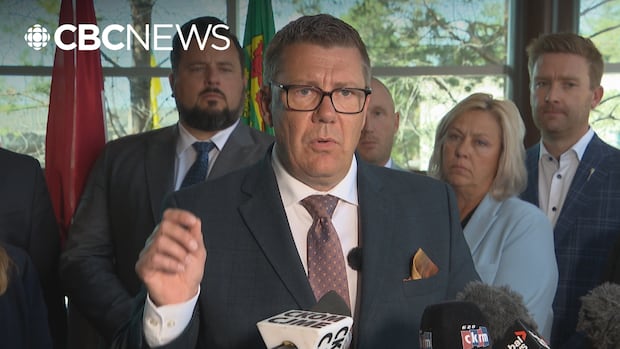
Premier Scott Moe called for Canadian unity and support for the federal government’s counter-tariffs on the United States, but said Saskatchewan will not support export taxes on potash or oil.
The premier indicated that the new counter-tariffs affect approximately $1.5 billion, which is 11.3 percent of Saskatchewan’s yearly imports from the U.S. He mentioned that the province is closely examining the list of counter-tariffs and collaborating with “affected industries to evaluate its potential repercussions on employment and consumer costs.”
On Wednesday, Moe reiterated to the press that export tariffs regarding potash and oil are not under consideration.
“What we cannot and will not condone as a province is any form of export tariff on our natural resources or any resources being exported to the U.S. or through the U.S. to other regions,” he asserted.
-
Canada’s big banks are shrugging off Trump’s trade war
-
Sask. premier endorses Canadian counter-tariffs, says they will apply to 11% of province’s U.S. imports
“We cannot support the imposition of export tariffs on a product like oil,” Moe declared, describing it as an unsustainable blow to industries in Saskatchewan and Alberta in particular.
According to Moe, Canadians would experience immediate job losses if such measures were enacted.
“An export tariff on oil would significantly impact residents in Eastern Canada more than those directly involved in the energy sector,” he noted.
The premier warned that an export tax on potash would have a “devastating” effect on Saskatchewan’s economy, resulting in much higher fertilizer prices that would impact farmers globally.
Tom McIntosh, a professor specializing in politics and international studies at the University of Regina, stated he was not surprised by the collapse of negotiations between Canada and the U.S.
“This is a challenging government to negotiate with,” he remarked.
The professor suggested that the province might eventually need to negotiate with the U.S., noting that Saskatchewan possesses substantial potash reserves critical for agricultural states in the U.S. that lack their own supply.
McIntosh pointed out that the only other major source of potash for the U.S. is located in Russia.
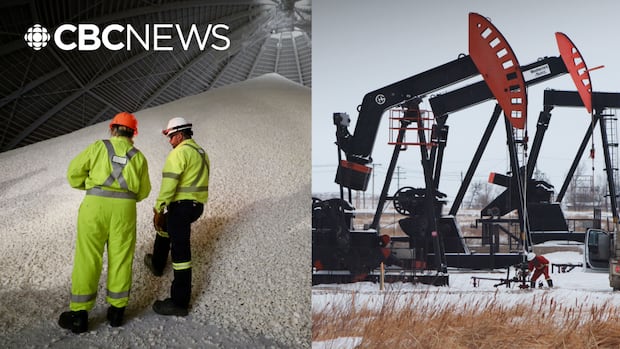
Saskatchewan Premier Scott Moe says while he supports Ottawa’s latest plans for reciprocal tariffs on some U.S. products, he will not support export tariffs on Canadian natural resources. ‘Canadians would lose jobs immediately,’ said Moe.
“Is it possible that we might impose export duties on potash? Everyone is hopeful that we don’t have to resort to that. However, it remains a possibility.”
In the meantime, the counter-tariffs also impact U.S. steel and aluminum. The local steel industry is keen on safeguarding the jobs of its workers.
“I appreciate the federal government’s announcement regarding targeted retaliatory actions, and we will support businesses and workers affected,” stated Scott Lunny, Western Canada director for the United Steel Workers Union.
Agricultural machinery is also included in the list of items affected by the counter-tariffs.
The Agricultural Producers Association of Saskatchewan (APAS) remarked that farmers are left with no option but to absorb the increased costs for parts and equipment.
“As we head into the harvest season, producers will be compelled to pay exorbitant prices for parts essential to keep machinery operational,” said Bill Prybylski, president of APAS.
Province examining support options
Moe indicated that the province is also assessing the federal government’s support initiatives to ensure they effectively assist businesses and workers.
“While this response to the recent U.S. tariffs is appropriate, we must not forget that all tariffs negatively impact businesses, employment, consumers, and families on both sides of the border. Our ultimate aim should be to restore a free and fair trading relationship with the U.S., which we have enjoyed for many years,” Moe stated.
Ultimately, Moe conveyed to reporters in Prince Albert that Canadians “should have a singular objective”: to return to negotiations and reach an agreement with their main trading partner.
“Through all the deliberate steps we take, our goal must be for both parties to return to the negotiation table,” he concluded, adding that the ideal resolution would be a trade arrangement beneficial for both Canadians and Americans.