Being the sole voice in the vast universe can feel quite isolating.
For those unaware, the quest for life — particularly intelligent life — has been pursued for many years. Yet, up to now, we appear to be alone.
Astronomers investigate the existence of life through two primary methods: searching for biosignatures, which indicate past or present biological activity (consider the Mars rovers), and technosignatures, which point to technology produced by an intelligent society. The latter largely relies on radio astronomy rather than optical methods, since any potential activity would be too distant for us to visually detect. Essentially, astronomers are tuning in for signals.
One leading organization in this field has been the SETI Institute. Established in 1984, it has been actively monitoring the sky for radio signals that might be journeying across the cosmos to greet us, the humble inhabitants of Earth. The institute has focused on star systems known to harbor exoplanets, yet signals from extraterrestrial sources remain undiscovered.
Recently, scientists from the Mountain View, California-based organization have devised an innovative approach to search for these signals by applying game theory. This new method not only examines where to look for signals but also when.
Game theory is a mathematical discipline that explores decision-making in interactive situations, where two “players” or “agents” have interdependent strategies. Each player considers the other’s strategy while remaining unaware of the other’s actions. The outcome hinges on the collective decision-making process.
In the context of the SETI Institute, the “Schelling point” concept from game theory is being utilized. A frequently referenced example by American economist Thomas Schelling involves two people planning to meet in New York City without a pre-established time or location. They may both independently decide to gather at Grand Central Terminal at noon, as it’s a well-known meeting spot and a sensible hour.
Now, consider this approach for detecting an alien civilization and think about the anti-solar point — a hypothetical location in the celestial sphere directly opposite the sun (180 degrees away). Visualize a straight line from the sun that extends through Earth into space.
What if there existed an alien civilization capable of observing Earth as it transits in front of the sun? What if they were aware of a planet orbiting our specific star and directed a signal towards us?
We have the location — Earth — and the timing — during a transit.
In essence, we’re meeting at Grand Central at noon.
Voices in the void
This anti-solar strategy was proposed years ago, but it lacked the necessary funding for implementation until now.
“I considered these concepts that have been simmering in the literature for a long time,” remarked Sophia Sheikh, a technosignature research scientist at the SETI Institute and the lead author of the study. “Now, the anti-solar point notion is finally receiving its moment in the spotlight.”
In their recent paper published on November 3, astronomers from the SETI Institute reported the detection of 1.9 million radio signals utilizing this method. However, after thorough filtering, none were identified as originating from extraterrestrial technology — all signals were traced back to Earth. It appears that we humans, with our satellites and radio transmissions, generate quite a racket.
Though this study excluded a portion of the sky, it doesn’t imply that nothing exists beyond. The universe is vast.
Consequently, they intend to persist with this method for a minimum of four years, according to Sophia Sheikh, the lead author and technosignature research scientist at the SETI Institute.

The Sun and our solar system in relation to the Milky Way galaxy. The white circle indicates the area where the majority of exoplanets have been found with current telescopes. (NASA/JPL-Caltech/T. Pyle)
They are searching for what is known as a narrowband signal, explained Sheikh, describing it as a “‘we are here’ … akin to an air horn, almost, within the radio frequencies.”
“Perhaps there’s information embedded within it, or the signal we identify could be what we refer to as a carrier wave. So the air horn signals, ‘Hey, there’s something intriguing here.’”
However, don’t envision astronomers sitting with headsets like Ellie Arroway in the 1997 film Contact. Instead, data is processed through computer programs.
The SETI Institute is utilizing the Allen Telescope Array, a set of 42 steerable 6.1-meter-diameter telescopes at the Hat Creek Radio Observatory in California — which has been operating in the search for alien signals since the 1980s.

Here is the Allen Telescope Array, the first radio telescope specifically designed for the search of extraterrestrial intelligence (SETI). Situated at the Hat Creek Radio Observatory in northern California, it comprises 42 antennas. (Simon Steel)
Science fiction?
The quest for extraterrestrial signals may appear to be a concept from science fiction. However, given that our Milky Way galaxy contains over 100 billion stars, there is a belief that someone must exist out there, particularly since we now understand that most stars host at least one exoplanet.
Furthermore, there’s the Drake equation, formulated by American astrophysicist Frank Drake in 1961. Its purpose was to estimate the number of civilizations in the Milky Way that might be capable of communication.
The outcome relies on numerous unknown factors, but it is certainly not zero.
Adam Frank, a professor of astrophysics at the University of Rochester in New York, is also on the lookout for technosignatures. He received NASA’s initial grant to investigate non-radio technosignatures, focusing instead on chemical signatures or other indicators of intelligent life.
He has noted that, historically, the search for extraterrestrial intelligence was not taken seriously.
“The giggle factor, which persisted throughout almost my entire career, has dissipated,” said Frank, alluding to the fact that the possibility was not considered credible decades ago. “It never made sense.”
This shift in perception became especially true after the discovery of exoplanets began in 1992, along with the first detection of an exoplanet orbiting a sun-like star in 1995.
In the event of a detection…
Imagine a scenario where a signal is detected. What would follow?
Believe it or not, there are established protocols outlined by the International Academy of Astronautics. Beyond the obvious necessity of confirming and verifying the finding, a significant protocol dictates: Do not respond. (If you have read or viewed 3 Body Problem by Liu Cixin, you will comprehend why this is a prudent guideline.)
-
‘Weird’ interstellar asteroid yields no alien signals, resembles worlds beyond Neptune
-
Scientists skeptical about recent claims that signs of life were possibly detected on exoplanet
However, this doesn’t pose a major challenge. Signals would be traversing light-year distances. For instance, if we received a signal from a star system located 100 light-years away and decided to reply, it would take 100 years for our response to reach the alien civilization, and another 100 years to get their reply back. That totals 300 years just to say, “Hello.”
“Communication is not our primary goal,” Frank stated.
Frank’s research delves into identifying technosignatures through the analysis of exoplanetary chemistry.
“For instance, we can examine the atmospheres of distant planets and search for substances like chlorofluorocarbons… a compound exclusively produced by industry,” he explained. “Such chemicals cannot be generated by nature or a biosphere.”
Thus, it is more about finding reassurance in knowing we are not solitary in the universe.
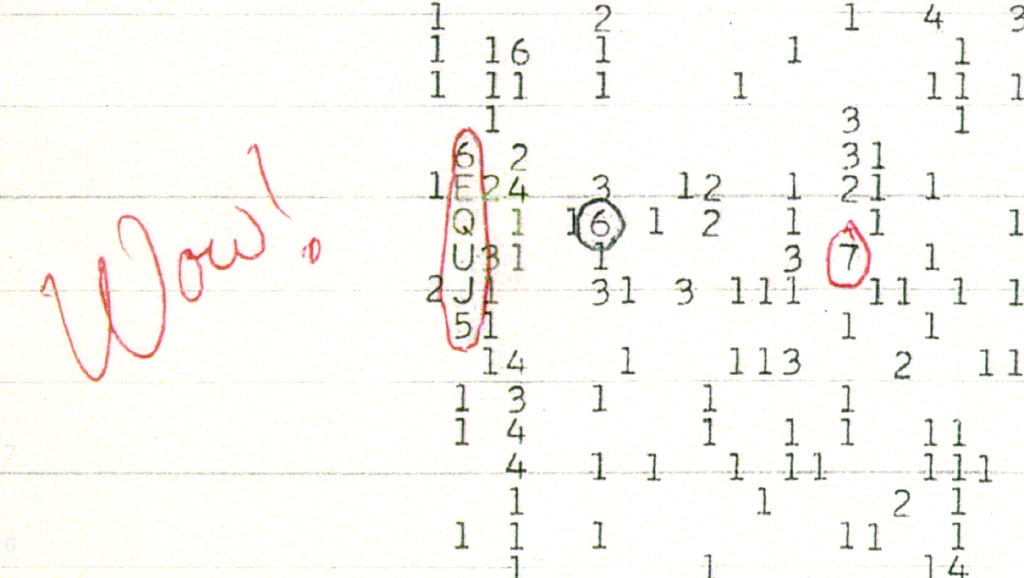
This image displays the printout of a strong signal recorded at the Big Ear Radio Observatory in 1977. Astronomer Jerry Ehman circled the unusual signal and annotated ‘Wow!’ in the margin. (Big Ear Radio Observatory and North American Astrophysical Observatory)
While a definitive radio signature indicating an alien civilization has yet to be discovered, there was the notable “Wow! Signal.” This intense radio signal was detected in 1977 by the Big Ear telescope in Ohio. It lasted for 72 seconds but was never observed again. Since that time, there has been speculation that it may have originated from passing comets.
So, when might we uncover an alien signal?
“The perspective I like to share,” Sheikh said, “is that I hope by the conclusion of my career, we will have an understanding of whether there are any radio signals in the galaxy originating from other technologically advanced civilizations.”