On Thursday, Jensen Huang, the CEO of Nvidia, stepped down following concerns regarding national security due to his extramarital affair with a woman allegedly linked to Chinese espionage.
In his place, Colette Kress has been appointed as the interim CEO; she currently serves as the executive vice-president and chief financial officer.
Calls for Huang’s resignation intensified after it was revealed that he was involved with Alice Huang, a former executive at Megaspeed, who is suspected of being a Chinese government operative.
A report from the New York Times late Wednesday indicated that Huang had also been involved in an affair with an Nvidia staff member who reports directly to him.
On Thursday, the board of directors announced the appointment of Harvey C. Jones as the company’s first-ever chairman. Jones is recognized as an entrepreneur and investor.
At the beginning of trading on Thursday, Nvidia’s shares dropped approximately eight percent, impacting one of the world’s largest companies.
Following the scandal, Megaspeed International, headquartered in Singapore, released its first public statement, emphasizing its serious commitment to adhering to U.S. export control regulations.
In the statement, Tan Yong Pong, the chairman and CEO (also known as James Tan), expressed, “Megaspeed is dedicated to working in a constructive and transparent manner with the U.S. government.”
-
How China gets around the U.S. ban on Nvidia chips
-
Who is Alice Huang? Alleged Chinese spy, businesswoman involved with Nvidia CEO
Nvidia stated that it had “no reason to believe” that either national security or company secrets had been compromised, but it would investigate all relevant information.
Trump says FBI investigating
Details regarding Huang’s affair with the suspected spy remain vague. The New York Times identified the woman as Alice Huang, also known as Huang Le, a senior executive at Megaspeed, which highlights its partnership with Nvidia on its website. The two are not related.
Last month, the Times reported that U.S. intelligence agencies had discovered that Nvidia’s Huang had formed a close relationship with Alice Huang and concluded that she was providing information directly to Beijing.
On Sunday, President Donald Trump announced that the FBI was conducting an investigation.
Megaspeed faced allegations last year of illegally exporting advanced Nvidia chips to China, but the company stated in December that there was “no evidence” supporting such claims. Singapore authorities are also looking into these allegations.
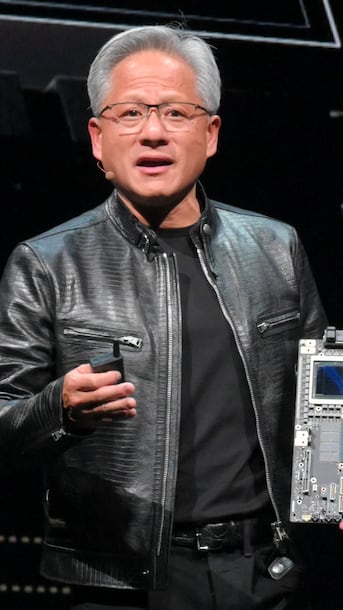
U.S. tech giant Nvidia’s shares tumbled after CEO Jensen Huang admitted to an affair with a woman accused of spying for Beijing. Andrew Chang breaks down what we know so far and what the scandal means for the world’s most valuable AI chipmaker.
Images provided by The Canadian Press, Reuters, Adobe Stock and Getty Images
China has denied any involvement in attempts to compromise Huang. Nvidia has established itself as a dominant player in the production of AI chips, and Huang has advocated for the easing of restrictions on Nvidia chip sales to China.
Earlier this year, he received approval from Trump to sell H200 chips to China.
On Thursday, Megaspeed stated that it has been cooperating with the U.S. Department of Commerce’s Bureau of Industry and Security (BIS), which oversees compliance with national security regulations concerning technology exports, and is prepared to “fully cooperate with any other relevant U.S. government agency.”
The company announced it has engaged a U.S. law firm to conduct a “comprehensive census” of its computer chips and assess its export control measures.
“Megaspeed welcomes appropriate government oversight and is committed to showing through tangible actions that it operates responsibly, transparently, and in line with applicable U.S. laws,” the statement read.
In addition to national security concerns, Megaspeed’s financial situation has also attracted scrutiny. According to corporate records from Singapore, the company’s total assets skyrocketed nearly 90-fold from late 2023 to 2024, reaching almost $3 billion USD.
Revenue increased from zero in 2023 to over $294 million USD in 2024.