The National Transportation Safety Board (NTSB) of the United States has announced plans to interview the two pilots who survived the Amazon cargo jet crash that occurred on Sunday in Miami. The NTSB has already secured data from the aircraft’s voice recorder, which was retrieved on Monday, but will not make that information public for the time being.
“The cockpit voice recorder captured over two hours of high-quality audio,” stated NTSB chair Jennifer Homendy during a briefing on Tuesday evening. “We are scheduled to speak with the pilots tomorrow, and we aim to gather their perspective on the incident before we disclose a summary of the cockpit voice recorder.”
NTSB investigator Chihoon Shin informed reporters during the same briefing that, 30 seconds prior to the conclusion of the flight data recording, both the nose landing gear and the right main landing gear made contact with the runway, followed by the left main landing gear 19 seconds before the end of the recording.
A moment later, he noted, the brakes were disengaged, and the throttles were adjusted to settings indicative of a go-around procedure.
Shin further mentioned that there was “no evidence in the recorded data suggesting that speed brakes or thrust reversers were activated.”
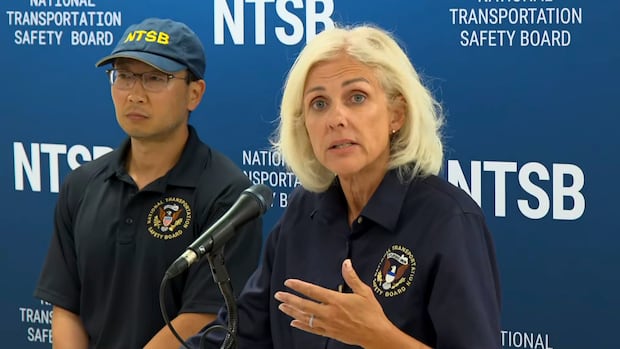
U.S. National Transportation Safety Board officials conduct a press conference following the Amazon Prime Air cargo plane crash on Sunday at Miami International Airport, resulting in five fatalities and five injuries when the aircraft veered off the runway and collided with vehicles.
Five fatalities on the ground
The aircraft overran the runway during its landing attempt on Sunday, crashing into a van located on airport premises, then proceeding to breach a fence before hitting an SUV on a city roadway.
All five people who lost their lives were occupants of a van owned by Professional Ocean Service Corp., a business that provides aircraft cleaning services. The company expressed that it would refrain from commenting on the incident out of respect for the families affected by the tragedy.
“Our employees mean far more to us than just coworkers; they are family, and they are cherished. Our thoughts and prayers are with every employee and every family whose lives have been irrevocably altered,” the company stated in a Tuesday release.
-
Investigators recover voice and data recorders from Amazon cargo crash at Miami airport
-
At least 5 dead after Amazon cargo plane barrels off Miami runway and smashes into cars: police
The Miami-Dade sheriff’s office has identified the deceased individuals as Rolando Aleman Leon, 55; Yoel Rodriguez Naranjo, 53; Julio C. Pineda, 75; Carlos Acosta Fajardo, 53; and Javierkys Reyes Quevedo, 47.
Additionally, five other individuals sustained injuries, with two in critical condition and a third reported to be stable, according to officials.
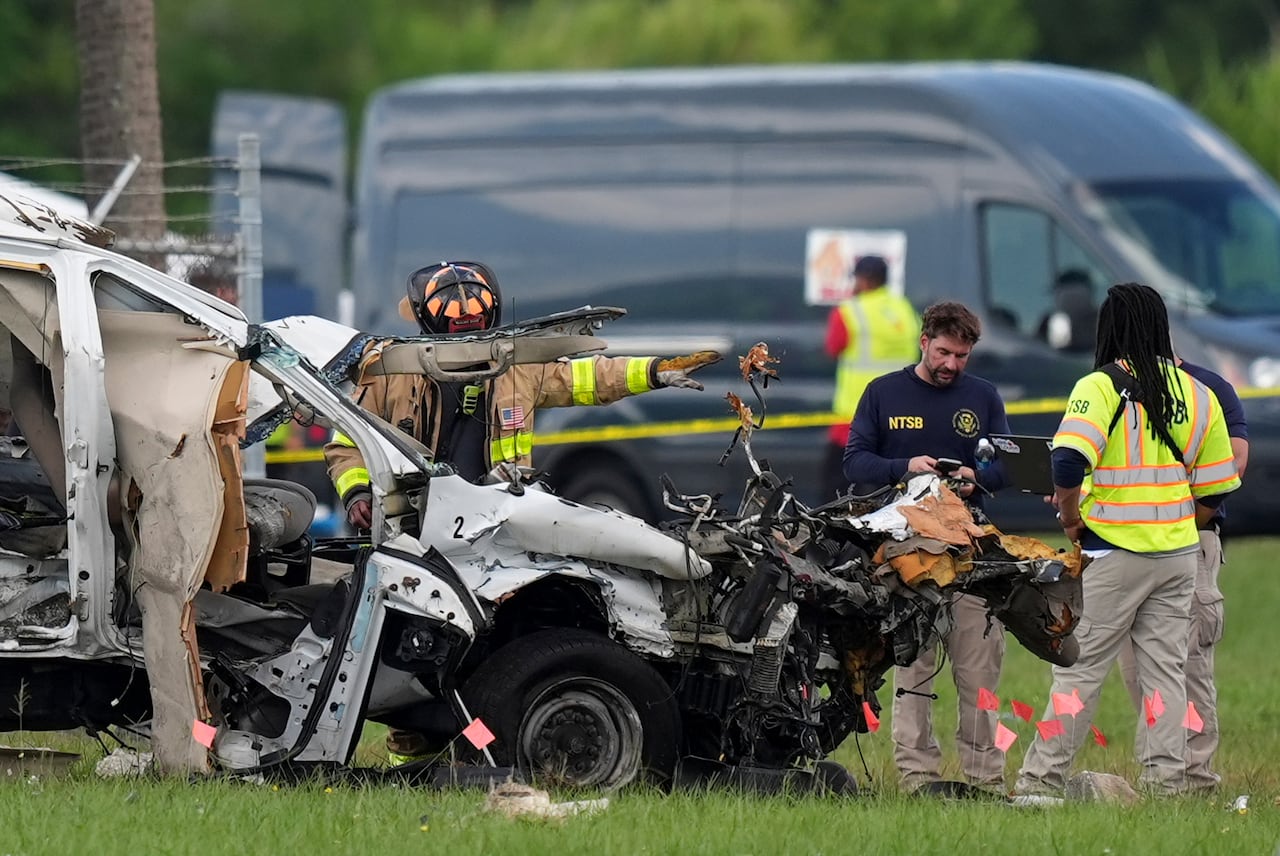
Investigators examine one of the vehicles that was damaged in the crash on Sunday. (Rebecca Blackwell/The Associated Press)
The severely damaged white van, its front end completely crushed, alongside the SUV, which was so mangled it was nearly unidentifiable, remained at the crash location on Tuesday, along with the jet, which was positioned nose-down with a significant soot mark close to the “P” in “Prime Air.”
The Amazon aircraft was landing following a two-hour journey from Puerto Rico, as storm conditions developed around the Miami airport.
According to the NTSB, the jet traveled approximately 396 meters beyond the runway’s end.
Miami’s airport lacks a runway excursion safety system, which is a lightweight, crushable material deemed by the Federal Aviation Administration to have saved around 500 lives.
Despite this, experts indicated that Miami’s airport seems to comply with federal regulations since it maintains a 305-meter safety buffer at the ends of its runways.
The flight was operated by 21 Air, a cargo airline based in North Carolina. The 32-year-old Boeing 767 was initially constructed for passenger transport and had flown for various international airlines for over twenty years before being converted for cargo operations in 2015, based on information from flight-tracking platform Flightradar24.
As of Tuesday, two of the four runways at Miami airport remained closed, and Homendy remarked that they would not be reopened until NTSB investigators have collected all necessary data from the crash site.