On Thursday, Canada’s Army initiated one of its most significant structural transformations in recent decades, transitioning from geographically based divisions to those organized around specific functions.
A ceremony and parade were held at Canadian Forces Base (CFB) Edmonton to officially establish the 1st Canadian Division, which will take on the primary role of executing large-scale combat missions and addressing crises.
Based in Edmonton, this “manoeuvre division” will consolidate various capabilities, including armored vehicles, artillery, light infantry, paratroopers, and engineering units.
The goal is to ensure the army can swiftly deploy a substantial force and maintain extended operations.
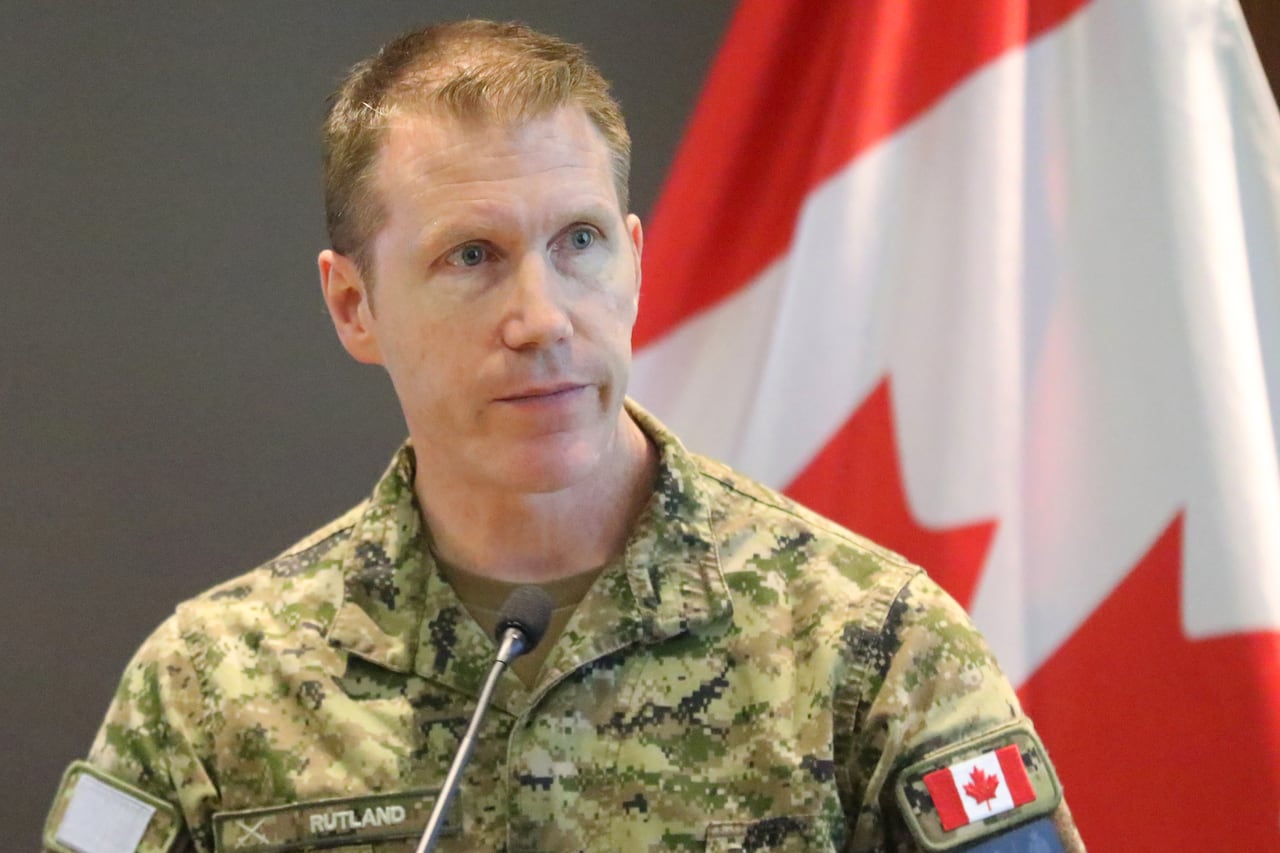
The adjustment aims to enhance the army’s responsiveness, noted Brig.-Gen. Wade Rutland, who is seen here speaking in Calgary in June 2025. (Dave Chidley/The Canadian Press)
Maj.-Gen. Wade Rutland, who leads the newly formed 1st Canadian Division, remarked in an interview, “This is a significant change.”
He emphasized, “This is not merely a reorganization. We are undertaking this to become more agile, more lethal, and more relevant in defending Canada.”
Rutland pointed out that the global threat landscape has evolved, with a resurgence of large-scale combat operations involving hundreds of thousands of troops, similar to the situation in Ukraine.
He stated, “We recognized the necessity to establish what we refer to as a war fighting division, which will assemble thousands of soldiers capable of integrating air, cyber, and space capabilities to effectively contribute as a reliable ally in potential future conflicts.”
This restructuring is part of broader changes initiated by Lt.-Gen. Michael Wright, who outlined his vision for modernizing the army in a 2025 document titled Inflection Point.
In addition to the manoeuvre division, a support division is being established, which will operate from Kingston, Ontario.
Moreover, the army is forming a “defence of Canada” division based in Montreal, designated as the 2nd Canadian Division. This division will primarily comprise part-time soldiers and focus on responding to national emergencies and domestic security.
The 3rd Canadian Division, which has its roots in the First World War and participated in the D-Day landings at Juno Beach in 1944, will be retired to the supplementary Order of Battle.
Retirement occurs when a regiment is deactivated but still exists in an administrative capacity for potential future activation.
Regular force personnel from the 3rd Division will be integrated into the 1st Division, while its reserves and rangers will join the 2nd Division, and support troops will transition to the support division.
Following these adjustments, the 1st Canadian Division, which has origins dating back to 1915 and was instrumental in capturing Vimy Ridge, will oversee three Canadian Mechanized Brigade Groups located in Edmonton, Petawawa, Ontario, and CFB Valcartier in Quebec.
Additionally, it will command the 3rd Light Infantry Regiment, the Canadian Artillery Brigade, the 6 Canadian Combat Support Brigade, and the 1 Canadian Sustainment Brigade.
Rutland expressed, “This holds great significance for us. The 1st Division was the first to engage in combat during the Second World War, leading major operations in Italy and Sicily.”