On Tuesday, the U.S. military reported that it had eliminated five Iranian oil tankers as retaliation for recent attacks on its naval vessels. In response, Tehran claimed to have targeted American positions in Jordan, marking the latest exchange in an ongoing conflict that has persisted for over six months.
Iranian state media indicated that, following the U.S. airstrikes, missiles were fired at U.S. sites in Jordan. The Jordanian military stated its air defense systems successfully intercepted 18 ballistic missiles aimed at its territory, while two others landed in uninhabited areas. There were no reported injuries.
As a reliable ally of the U.S. that accommodates American forces, Jordan has become a frequent target for Iranian attacks against its military bases. The U.S. Central Command mentioned it had no further information to provide.
These recent actions are part of a combined economic and military strategy by U.S. President Donald Trump, who is seeking to end the conflict.
On Tuesday, the Trump administration also implemented new sanctions against various sectors of Iran’s aviation industry, targeting more than 25 commercial and private airlines as well as international cargo service providers to further isolate Tehran from its trading partners.
Both the United States and Iran are vying for dominance over the Strait of Hormuz, through which approximately 20% of the world’s oil passed prior to the conflict that began on February 28.
Soaring energy prices are creating political challenges for Trump and his Republican Party as they approach the November midterm elections. On Tuesday, the price of Brent crude, a global benchmark, peaked at $99.46 per barrel.
Exchange carrying over from weekend
On Saturday, U.S. forces also destroyed three Iranian oil tankers after the Islamic Revolutionary Guard Corps (IRGC) attempted to strike a U.S. aircraft carrier and destroyer with ballistic missiles, warning that they would “if necessary, destroy Iran’s limited and exposed oil fleet.”
Iran subsequently announced plans to declare a new “exclusion zone” near the Strait of Hormuz for vessels planning to navigate through it.
Secretary of State Marco Rubio asserted that the U.S. would not permit Iran’s assaults to go without a response.
“Iran continues its attempts to strike U.S. naval ships. For every such attempt, they will lose tankers. I believe we will witness that again today,” Rubio remarked to reporters on Tuesday during his visit to Colombia.
Danny Citrinowicz, an expert on Iran at Israel’s Institute for National Security Studies, cautioned that these reciprocal attacks could lead to further retaliation and adverse effects on the global economy.
“There is no kinetic solution to the Strait of Hormuz dilemma,” he expressed on social media. “Every effort to enforce one only brings Washington and Tehran closer to an escalation that may become harder to manage.”
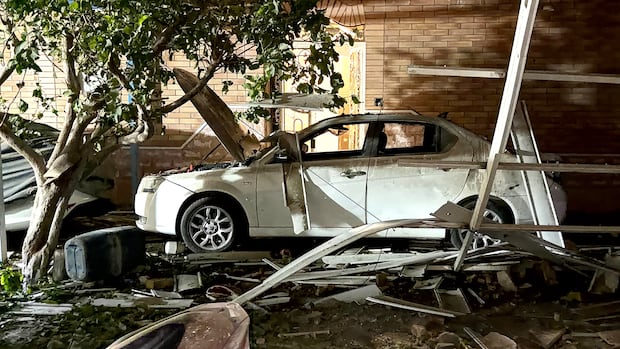
Iran targeted multiple U.S. bases across the Persian Gulf on Wednesday after accusing the U.S. of launching a strike that killed four people at a wedding in southern Iran. U.S. Central Command told CBC News it’s investigating the claims.
According to U.S. Central Command, the Iranian tankers destroyed on Tuesday included the Kivik, Charminar, Horizon 1, and the Riesco, located in the Gulf of Oman. Additionally, the U.S. military targeted the Derya, which was near Kharg Island in the Strait of Hormuz. The statement noted that the crews of all five vessels were instructed to abandon ship prior to the assaults.
Iranian state television confirmed the U.S. attacks, stating that American forces struck Iranian oil tankers close to the southern port of Jask and near Kharg Island in the Persian Gulf. It reported that the crews were evacuated.
An Iranian state TV correspondent in Jask reported that one tanker was targeted near Yekbeni’s coast. Later, state media indicated a second tanker was hit in waters off Jask, alongside reports of another tanker being attacked in the anchorage area near Kharg Island.
On Tuesday, the IRGC navy warned oil tanker crews near ports in Kuwait and Bahrain to immediately vacate their vessels, as they could be targeted in retaliation for U.S. strikes on Iranian tankers. They accused Kuwait and Bahrain of hosting U.S. military personnel and aiding in the attacks.
The U.S. blockade of Iranian ports has significantly impacted the nation’s economy by restricting oil exports, while the American military has been facilitating a limited number of ships’ passage through a route in the Strait of Hormuz off Oman.
Tehran desires that vessels follow a route of its choosing through the strait, which was previously recognized as an international waterway before the conflict.